A plant manager should arrange emergency compressed air rental the moment a compressor failure threatens production continuity and no internal backup is available to cover the shortfall. The decision point is straightforward: if your compressed air supply is down or critically reduced and your process cannot run without it, the call needs to be made immediately. The sections below answer the specific questions plant managers and maintenance engineers face when that moment arrives.
What counts as a compressed air emergency in a plant?
A compressed air emergency is any unplanned event that reduces or eliminates your compressed air supply below the level needed to sustain production. This includes sudden compressor failure, a major leak or burst in the distribution network, a catastrophic bearing failure, an electrical fault that takes a machine offline, or a fire or flood that disables your compressor room entirely. If production has stopped or is about to stop because of it, it is an emergency.
The threshold is not just total loss. A partial failure that drops capacity below your minimum process requirement is equally critical. In industries where compressed air quality is non-negotiable, such as food and beverage, pharmaceutical, or chemical processing, even a degraded supply that no longer meets the required purity specifications can force a shutdown just as effectively as a complete outage. Running on reduced or contaminated air risks product quality, regulatory compliance, and equipment downstream.
Some situations escalate faster than others. A single compressor failure at a site with redundancy may give you hours to respond. A failure in a single-compressor plant, or a fault that takes out your entire compressor room, demands an immediate response. The defining question is always the same: how long can your process run before the absence of compressed air causes irreversible damage to production, product, or equipment?
Many industrial plants operate on an N+1 redundancy principle, meaning they run the number of compressors required to meet demand — N — plus one additional standby unit held in reserve. When the standby compressor itself fails or is taken offline for maintenance, the plant loses its safety margin entirely. In this situation, hiring a temporary compressor to restore that reserve capacity is a practical and immediate solution, even if production has not yet been interrupted. Acting before a second failure occurs is always preferable to reacting after one.
Need Reliable Oil-Free Compressed Air?
Our experts help you find the right compressed air rental solution for your industrial needs.
How quickly can an emergency oil-free compressor be delivered and running?
Delivery timelines for emergency compressed air rental depend on your location, the equipment configuration required, and the supplier’s available fleet. In practice, a specialist rental supplier with a well-maintained European fleet can mobilise equipment within hours to a small number of days for most industrial locations. The closer you are to a major logistics hub and the simpler your site requirements, the faster the response.
What affects the timeline most is not the transport itself but the site preparation and connection work. A straightforward installation connecting to an existing electrical supply with standard hose connections can be commissioned in a matter of hours once equipment arrives on site. A more complex installation involving medium-voltage connection, desiccant drying, large buffer receivers, or bespoke pipework will take longer, even if the equipment arrives quickly.
This is why calling a specialist early matters. A supplier who handles logistics, installation, and start-up in-house, rather than subcontracting each phase, can compress the total time from first call to running production significantly. RTC Group covers the full scope from system design and project management through to delivery, installation, and commissioning, which reduces coordination delays and keeps accountability with a single team.
What types of oil-free rental compressors are available for emergency use?
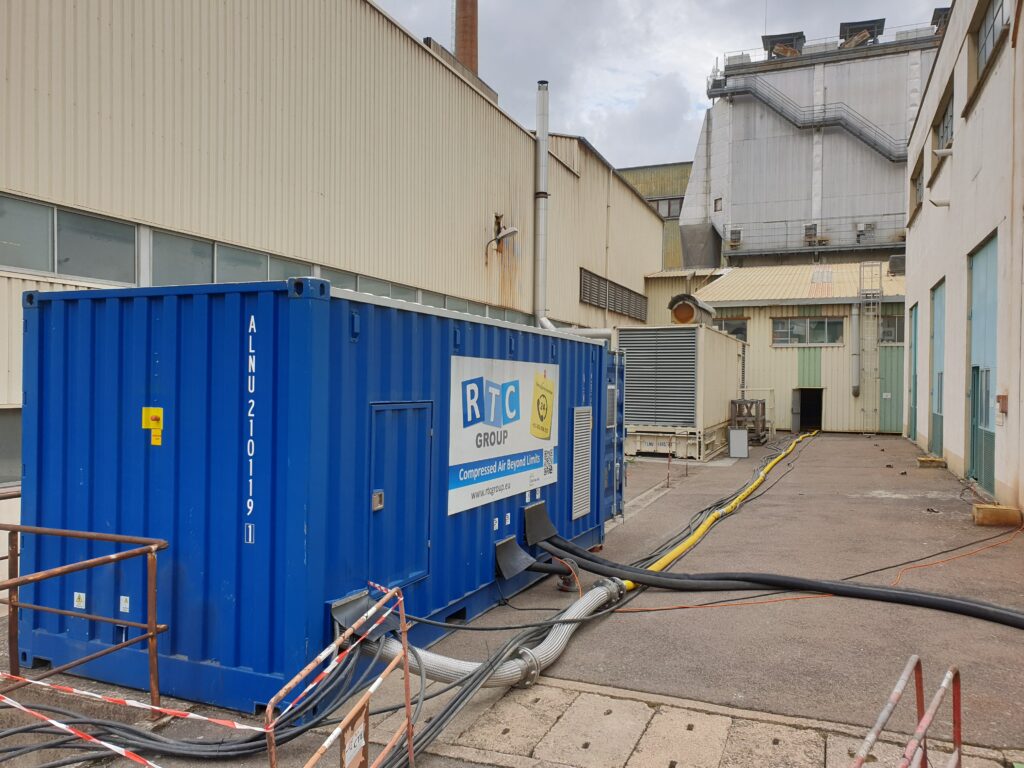
For emergency industrial use, oil-free rental compressors are available in four main configurations: low-voltage electric, medium-voltage electric, diesel, and hybrid. Each suits different site conditions and urgency profiles, and the right choice depends on what power infrastructure is available and how quickly you need air flowing.
- Low-voltage electric compressors connect to a standard 400 V supply and are the most common emergency solution for sites with accessible low-voltage power. They deliver compressed air that meets the ISO 8573-1 Class 0 purity classification — meaning the air contains no detectable oil — and are well suited to a wide range of industrial applications where oil contamination cannot be tolerated.
- Medium-voltage electric compressors connect directly to an existing medium-voltage supply, eliminating the need to install a large temporary transformer. This is a significant advantage when speed is critical and low-voltage infrastructure is not readily available near the point of use.
- Diesel oil-free compressors are fully self-contained and require no electrical connection at all. They are the fastest option to deploy at sites where power access is unavailable or has been disrupted, and they still deliver oil-free compressed air meeting the same purity standards as their electric equivalents.
- Hybrid oil-free compressors start on diesel and switch to mains electricity when a supply becomes available. This makes them particularly well suited to emergencies where power restoration is expected but not yet confirmed, allowing production to restart immediately without waiting for the grid connection to be re-established.
Beyond the compressor itself, a complete emergency installation typically includes air dryers, buffer receivers, and any necessary electrical distribution. Desiccant dryers are used where the process requires very low dew points, as seen in projects where dew points of -40 degrees C were specified. Refrigerant dryers cover the majority of standard industrial applications. The right combination depends on your process requirements, not just the compressor capacity. You can review the available rental equipment to understand what a complete temporary system typically involves.
What’s the difference between emergency rental and planned temporary compressed air?
The key difference between emergency rental and planned temporary compressed air is the lead time available and the degree of preparation possible on both sides. Emergency rental is reactive, triggered by an unplanned failure, and requires the supplier to mobilise fast with whatever best-fit equipment is available. Planned temporary rental is proactive, arranged in advance around a known event such as a scheduled maintenance shutdown, a facility upgrade, or a capacity expansion.
Emergency rental: speed over optimisation
In an emergency, the priority is restoring compressed air supply as quickly as possible to limit production losses. Equipment selection is constrained by what is in the rental fleet and available immediately. The installation scope may be simplified to get air flowing fast, with refinements added once the immediate crisis is stabilised. Costs are typically higher because of the urgency and the resources required to mobilise at short notice.
Common triggers for emergency rental include unexpected compressor failures, the loss of a standby unit that was providing N+1 redundancy, electrical faults that disable a compressor room, and situations where a planned maintenance window overruns and production cannot wait. In each case, the goal is the same: restore supply before the production impact becomes irreversible.
Planned temporary rental: optimisation over speed
Planned temporary compressed air supply allows time for proper system design, equipment selection matched precisely to process requirements, site surveys, and a structured installation programme. The supplier can specify the ideal compressor size, dryer type, and ancillary equipment without the pressure of an active production shutdown. Rental durations for planned projects range from weeks to multiple years, and the commercial terms can be negotiated more carefully. Projects such as a 22-week installation at a steel factory in Finland or a six-month rental at a food factory in the Netherlands illustrate what a well-scoped planned rental looks like in practice.
Both scenarios benefit from using a supplier who manages the full scope in-house. The difference is that in an emergency, that single-supplier model becomes essential rather than simply convenient.
Which industries most commonly need emergency compressed air rental?
Industries that most commonly need emergency compressed air rental are those where compressed air is a core process utility and any interruption immediately halts production. The sectors with the highest urgency profile are food and beverage, pharmaceutical, metal production, chemical and petrochemical, and PET bottle blowing. In each of these, a compressor failure does not just slow production; it stops it entirely or creates an immediate compliance or contamination risk.
Food and beverage manufacturers rely on oil-free compressed air for direct product contact applications, packaging, and process automation. A failure here can mean halted filling lines, product spoilage, and regulatory exposure. Pharmaceutical plants face similar consequences, with GMP compliance requirements meaning that any air supply that does not meet the required purity specification is not an acceptable substitute for validated production air.
Metal producers, particularly steel and aluminium smelters, run large-volume compressed air systems continuously, but the specific applications differ significantly between the two. In steel production, compressed air is used for pneumatic control systems, furnace combustion air, and cooling. In aluminium smelting, compressed air serves additional critical functions: it is used to cool the electrolytic reduction cells — known as pots — where aluminium is produced through the Hall-Héroult process, as well as for point feeder systems that introduce alumina into the pots and for general plant instrumentation and control. A compressor failure at an aluminium smelter can therefore affect cell stability and temperature control directly, with consequences that extend well beyond a simple production pause. The Iceland aluminium smelter project, which required two electric oil-free compressors delivering a combined 206 cubic metres per minute alongside three desiccant dryers, illustrates the scale and technical specificity at which emergency rental can operate.
Chemical and gas separation plants also appear regularly in emergency rental scenarios because their processes often run continuously and depend on precise air quality. Waste treatment facilities, textile manufacturers, and paper mills round out the common emergency caller profile. Across all of these, the common factor is that compressed air downtime translates directly and immediately into financial loss.
What should a plant manager check before calling a rental supplier?
Before calling a rental supplier, a plant manager should gather the key technical parameters that define what equipment is needed. Having this information ready at the point of first contact accelerates the supplier’s ability to propose the right solution and reduces the time between the call and a confirmed rental agreement.
The most important information to have available includes:
- Required flow rate in cubic metres per minute or cubic feet per minute, ideally the minimum needed to sustain production rather than the full installed capacity.
- Required working pressure at the point of use, not just at the compressor outlet.
- Air purity requirements, including whether the process requires oil-free air meeting ISO 8573-1 Class 0 and what dew point the process demands. These are technical specifications that define what the delivered air must achieve, not supplier credentials.
- Available power supply, specifically whether low-voltage (400 V), medium-voltage, or no mains power is accessible near the installation point.
- Site access details, including space available for equipment, access routes for delivery vehicles, and any height or weight restrictions.
- Connection points, particularly where the temporary supply will tie into the existing distribution network.
- Estimated rental duration, even a rough estimate, as this affects equipment specification and commercial terms.
If some of this information is not immediately available, do not let that delay the call. A specialist supplier can help work through the technical parameters as part of the initial conversation. The rental process at RTC Group includes technical assessment as part of the engagement, so even partial information is enough to start. The sooner contact is made, the sooner equipment can be mobilised. If you are ready to act, reaching out directly is the fastest path to getting a qualified solution on site.