

Oil-lubricated compressors pose a direct contamination risk in food processing because lubricating oil can carry over into the compressed air stream and reach food products, packaging, or processing equipment. Even trace quantities of oil aerosol, oil vapour, or degraded oil residue in contact air can introduce hydrocarbons, microbial contamination, and chemical taints into the food chain. The sections below unpack each dimension of that risk, from the physical pathways oil takes through a compressed air system to what regulators and standards actually require.
How does oil from a compressor actually reach the food product?
Oil from a lubricated compressor reaches food through the compressed air distribution system. During compression, lubricating oil is atomised into fine aerosols and vapours that travel downstream with the air. Unless every stage of the treatment train performs exactly as designed, those particles exit at point-of-use outlets and come into direct or indirect contact with food, surfaces, or packaging.
The pathway is not always obvious. Oil does not travel as a visible liquid stream; it moves as submicron aerosol droplets and as vapourised hydrocarbons that condense further along the pipework. Several factors make the journey more likely:
- Worn or degraded compressor seals allow higher-than-normal oil carryover from the compression chamber.
- Overloaded or poorly maintained coalescing filters become saturated and lose their separation efficiency, releasing accumulated oil back into the airstream.
- High operating temperatures increase the vapour fraction of oil, which passes through particulate filters without being captured.
- Pressure fluctuations can dislodge accumulated condensate and oil residue from pipework walls and push it downstream in slugs.
- Long distribution lines provide more surface area for oil to coat, creating a reservoir that releases contamination over time.
Once oil reaches a food processing environment, the exposure routes multiply. Compressed air used for direct product contact, such as blowing, conveying, or pneumatic cutting, carries contamination straight onto or into the food. Air used to operate packaging machinery, clean surfaces, or pressurise tanks can transfer oil to contact surfaces that then touch the food. Even air used only to actuate valves and cylinders can vent into the production space, contributing to airborne contamination.
Need Reliable Oil-Free Compressed Air?
Our experts help you find the right compressed air rental solution for your industrial needs.
What are the specific health and safety risks of oil in food-grade air?
The health and safety risks of oil contamination in food-grade compressed air fall into three categories: chemical toxicity, microbiological hazard, and product integrity failure. Mineral oils used in compressor lubrication are not approved food additives, and their presence in food constitutes adulteration under food safety law in most jurisdictions.
Chemical and toxicological hazards
Mineral and synthetic compressor lubricants contain hydrocarbon compounds, additives, and anti-oxidants that are not intended for human ingestion. At elevated temperatures, lubricating oil degrades into carbonaceous deposits and oxidation by-products that are chemically distinct from the original lubricant and potentially more harmful. Even food-grade lubricants, which are formulated from incidental-contact-approved base stocks, are not approved for deliberate addition to food; their presence in compressed air is still a contamination event.
Microbiological amplification
Oil residue coating the interior of compressed air pipework creates an ideal environment for biofilm formation. Bacteria and moulds that would otherwise be flushed through the system can colonise oil-coated surfaces and multiply. When airflow disturbs these biofilms, microbial contamination enters the airstream alongside the oil. In chilled or refrigerated processing environments, some of these organisms are psychrotrophic and remain active at low temperatures, making the risk persistent.
The combination of chemical and microbiological risk means that oil contamination from a lubricated compressor is not simply an aesthetic or quality problem. It is a food safety hazard that can trigger product recalls, regulatory action, and serious harm to consumers.
Which food processing applications are most vulnerable to oil contamination?
Food processing applications where compressed air contacts the product directly or contacts product-contact surfaces are the most vulnerable to oil contamination. These include pneumatic conveying of dry ingredients, blow-moulding of food-grade packaging, direct-contact cleaning and drying of products, and gas flushing of modified-atmosphere packaging.
Specific applications that carry the highest contamination risk include:
- Pneumatic conveying of powders and granules: flour, sugar, spices, and dried ingredients pass through the air stream continuously, giving oil aerosol direct and prolonged contact with the product.
- Blow-moulding of PET bottles and containers: the air used to form the container interior contacts the internal surface that will hold the food or beverage. High-pressure air at this stage must be demonstrably oil-free.
- Product drying and cooling: air blown across fruit, vegetables, meat, or baked goods transfers any contamination directly onto the product surface.
- Modified atmosphere packaging (MAP): nitrogen or CO₂ blanketing systems often use compressed air at upstream stages; any oil contamination can compromise the integrity and safety of the sealed atmosphere.
- Cleaning-in-place (CIP) and surface blow-off: air used to purge lines or blow moisture from surfaces after washing can reintroduce contamination immediately before packaging.
Applications where air only operates actuators and cylinders in a sealed system carry lower direct risk, but venting and leakage in a food production environment still create an indirect pathway. For this reason, food safety auditors typically assess the entire compressed air system, not only the direct-contact points.
What do food safety regulations say about compressed air purity?
Food safety regulations do not generally specify compressor types by name, but they require that compressed air used in food processing does not become a source of contamination. Under frameworks such as the EU General Food Law Regulation, HACCP principles, and British Retail Consortium (BRC) Global Standards, compressed air in contact with food or food-contact surfaces must be identified as a potential hazard and controlled accordingly.
The relevant international technical standard for compressed air purity is ISO 8573-1, which classifies air quality across three parameters: particulate matter, water content, and total oil content. Food and beverage manufacturers typically reference this standard when specifying acceptable air quality for their processes. The oil content classes range from Class 1 (maximum 0.01 mg/m³ total oil) through to Class 0, which requires the equipment supplier and the customer to agree a purity level more stringent than any other class in the standard.
It is important to understand that ISO 8573-1 describes air quality at the point of measurement; it is a purity classification, not a certification that a supplier holds. Whether delivered air meets a particular class depends on the compressor technology, the treatment train, and the conditions at the point of use. Regulatory compliance in food processing therefore requires documented evidence that the compressed air actually delivered meets the agreed specification, not simply a claim about the equipment used.
Major retailer codes of practice and food safety certification schemes such as IFS Food and FSSC 22000 go further, requiring that compressed air quality be monitored, tested, and recorded as part of the food safety management system.
Can filtration alone make oil-lubricated compressor air safe for food use?
Filtration alone cannot reliably make oil-lubricated compressor air safe for food use in direct-contact applications. While a well-maintained, correctly specified filter train can reduce oil content significantly, it cannot eliminate oil vapour, it depends entirely on consistent maintenance, and it introduces a failure mode (filter saturation) that can release accumulated contamination in a single event.
The technical limitation is straightforward. Coalescing filters capture oil aerosol by causing droplets to merge and drain away, but they have no mechanism for removing oil vapour, which is a molecular-level contaminant. Activated carbon adsorbers can address vapour, but their capacity is finite and they must be replaced before breakthrough occurs. In a production environment where filter change intervals are driven by time schedules rather than real-time monitoring, breakthrough is a realistic risk.
There are additional practical concerns:
- Filters add pressure drop to the system, which increases energy consumption and can reduce available pressure at point of use.
- A failed or saturated filter can release a concentrated slug of previously captured oil, causing a contamination event far worse than the baseline carryover from the compressor.
- Downstream pipework that has been coated with oil residue over time continues to release contamination even after filters are replaced or upgraded.
- Verification requires regular oil content testing at point of use, which adds cost and complexity to the food safety management system.
For these reasons, food safety professionals and technical guidance from organisations such as the British Compressed Air Society consistently recommend that direct-contact food processing applications use genuinely oil-free compression technology rather than relying on filtration of oil-lubricated compressor output. The risk is not just about whether the filter works today; it is about what happens when it does not.
What is the difference between ISO Class 0 and food-grade compressed air?
ISO Class 0 and food-grade compressed air are related but not the same thing. ISO Class 0 is a purity classification within the ISO 8573-1 standard, defined as an air quality level more stringent than Class 1 for particulate, water, and oil content, with the exact limits agreed between supplier and user. Food-grade compressed air is a broader concept that encompasses not only oil content but also microbial contamination, taste and odour, and regulatory compliance with food safety law.
ISO Class 0 specifically addresses the oil content parameter. An oil-free compressor (one that uses no lubricant in the compression chamber) is the most reliable way to achieve oil content at Class 0 levels, because it eliminates the source of oil carryover rather than treating the symptom. This is fundamentally different from a technically oil-free arrangement, where a lubricated compressor feeds a downstream filtration train to reduce oil content to Class 1 levels. The distinction matters because the two approaches carry very different risk profiles for food production environments.
For food processing, meeting ISO 8573-1 Class 0 for oil content is a necessary but not sufficient condition for calling air food-grade. A complete food-grade compressed air specification also needs to address:
- Microbial content: not covered by ISO 8573-1, but addressed in ISO 8573-7 and required by food safety management standards.
- Water content: moisture supports microbial growth and can cause product quality problems; desiccant dryers are often required for the lowest dew points.
- Taste and odour: compressed air that contacts food must not impart any detectable flavour or smell, which requires attention to pipework materials and cleaning as well as air treatment.
- Documentation and traceability: food safety auditors require evidence that the air meets specification, not just a claim about the equipment.
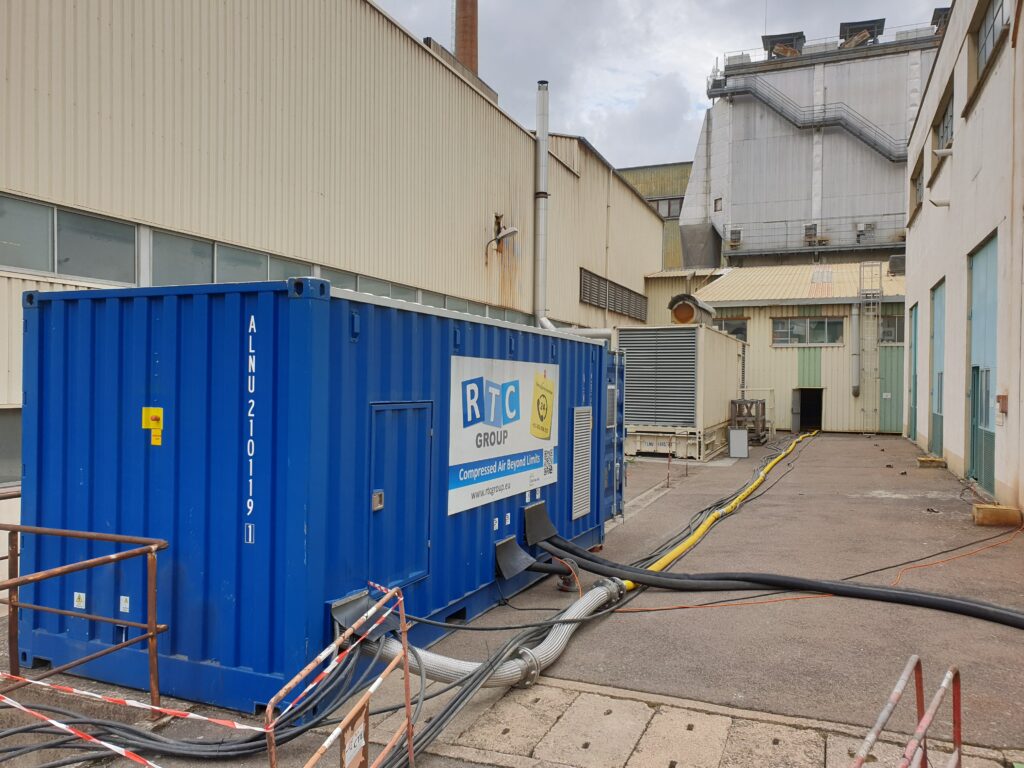
For food manufacturers evaluating their compressed air supply, the practical question is whether the entire system, from compression through treatment to point of use, can be demonstrated to meet the food safety specification consistently. RTC Group works with food and beverage producers across Europe to supply oil-free compressor rental solutions for applications where contamination-free air is a production requirement, including planned maintenance periods and emergency cover when existing equipment fails. The starting point is always the compression technology itself, because no treatment train can fully compensate for a contamination source that should not be there in the first place.