

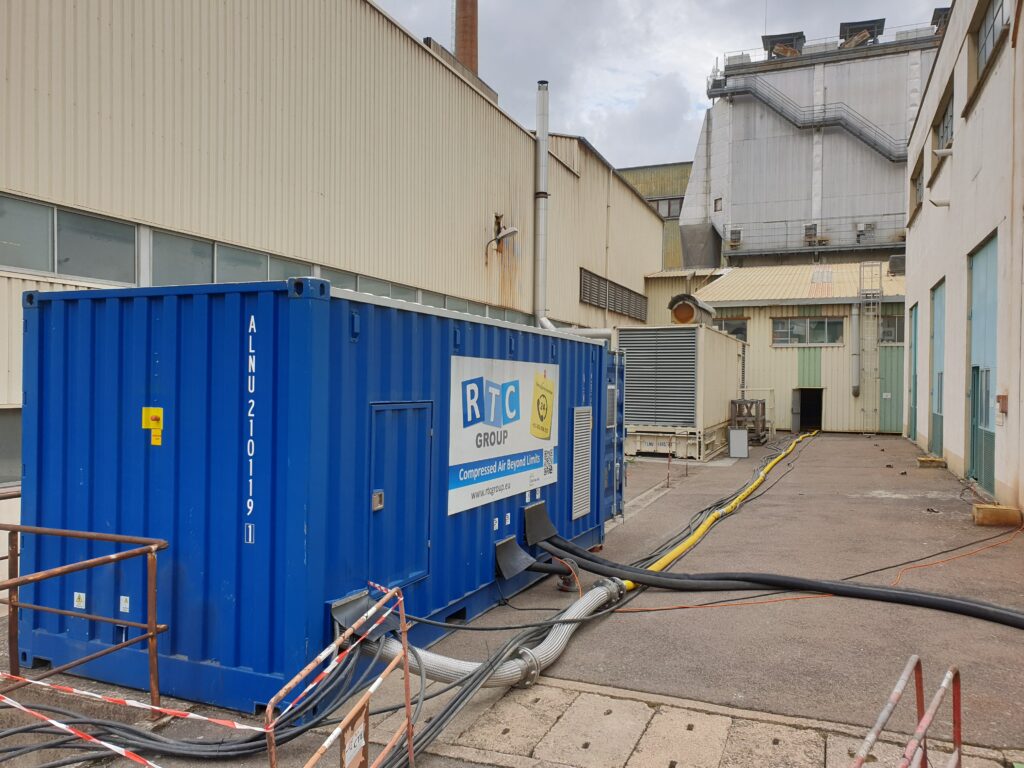
A centrifugal compressor differs from a rotary screw compressor in its fundamental operating principle: centrifugal machines use high-speed rotating impellers to accelerate air and convert velocity into pressure, while rotary screw compressors trap and compress air between two meshing helical rotors. The practical consequence of this difference is significant: centrifugal compressors are inherently oil-free by design and excel at delivering very large, continuous volumes of air, whereas rotary screw machines are more compact and flexible across a wider range of flow rates. The sections below unpack the key questions that industrial buyers ask when evaluating these two compressor types.
Which industries are best suited to centrifugal compressors?
Centrifugal compressors are best suited to industries that require large, continuous volumes of oil-free compressed air at stable pressure. The ideal applications are those where demand is high and relatively constant, contamination is unacceptable, and the cost of downtime is severe. Key sectors include steel and aluminium production, chemical and petrochemical processing, large-scale food and beverage manufacturing, pharmaceutical production, PET bottle blowing, glass manufacturing, and gas separation.
What these industries share is a combination of high air consumption and zero tolerance for oil contamination, but the specific role of compressed air differs meaningfully between them. In aluminium smelting, compressed air is used for multiple purposes: it drives pneumatic control systems, supports material handling, and — critically — provides cooling air for the electrolysis cells, known as pots, where aluminium is produced through the Hall-Héroult process. Maintaining adequate airflow to these cells is essential for temperature control and cell integrity; any interruption risks damage to the pot lining and significant production loss. In steel production, compressed air supports blast furnace operations, pneumatic conveying of materials such as pulverised coal, and process instrumentation throughout the plant. A pharmaceutical or food facility, by contrast, requires absolutely clean air because compressed air contacts the product or its packaging directly, making contamination a safety and regulatory issue rather than purely an operational one.
Centrifugal compressors are also the preferred choice for facilities that operate continuously rather than intermittently. Because the machines run at high speed with no oil in the compression chamber, they deliver air with no oil content by design, without the need for oil-removal filtration downstream. For industries where regulatory compliance, product safety, and production continuity all depend on air purity, this is a decisive advantage. RTC Group’s centrifugal compressor rental fleet serves exactly these sectors across Europe, including completed projects at aluminium smelters, steel factories, chemical plants, and food production facilities.
Need Reliable Oil-Free Compressed Air?
Our experts help you find the right compressed air rental solution for your industrial needs.
How does a centrifugal compressor generate compressed air?
A centrifugal compressor generates compressed air through dynamic compression. Ambient air enters the machine through an inlet and is drawn into a high-speed rotating impeller. The impeller accelerates the air to very high velocity, and that kinetic energy is then converted into pressure as the air passes through a stationary diffuser. This process is repeated across multiple stages to reach the target discharge pressure.
The key mechanical components are the impeller, the diffuser, and, in multi-stage machines, the intercoolers that remove heat between stages. Because compression is achieved through velocity and fluid dynamics rather than positive displacement, there is no contact between moving parts in the compression path. No oil is needed for lubrication or sealing within the air stream, making centrifugal compression inherently oil-free.
Capacity control in centrifugal compressors is typically achieved through inlet guide vanes (IGVs) or inlet butterfly valves (IBVs). IGVs impart a pre-swirl to incoming air, reducing the work the impeller must do during turndown, which makes them more energy-efficient at partial load compared to IBVs, which simply restrict the inlet flow. The specific control mechanism fitted to a machine matters when evaluating part-load efficiency, and it is worth confirming which system a given unit uses before selection.
The result is a machine that can deliver very high flow rates (units in RTC Group’s fleet, for example, reach capacities of 6,200 m³/h or more) at sustained pressures suitable for heavy industrial processes, all without introducing oil into the compressed air stream.
How does a rotary screw compressor work differently?
A rotary screw compressor works through positive displacement rather than dynamic compression. Two helical rotors, one male, one female, mesh together inside a casing. As they rotate, air is drawn in at the inlet, trapped in the cavities between the rotor threads, and progressively compressed as the cavity volume reduces along the length of the rotors until the air is discharged at the outlet.
Unlike centrifugal machines, rotary screw compressors operate at much lower rotational speeds and produce compressed air in a near-continuous flow rather than through velocity conversion. In oil-injected screw compressors, oil is introduced into the compression chamber to seal clearances, lubricate the rotors, and remove heat. That oil must then be separated from the compressed air downstream before the air can be used. Oil-free screw compressors eliminate oil from the compression chamber entirely, using precision-machined rotors with tight tolerances and external bearing lubrication systems to maintain separation.
Many modern oil-free screw compressors include variable speed drives (VSDs), which allow the motor speed, and therefore the output flow, to be adjusted to match demand. This makes them well suited to applications where air consumption varies significantly throughout a shift or production cycle. However, it is worth noting that large oil-free screw compressors above roughly 200 kW can lose efficiency at reduced speeds, because internal leakage becomes proportionally more significant at low load. Evaluating the actual duty profile, not just the nominal power rating, is important when selecting a large VSD screw machine.
In summary, rotary screw compressors are more compact, more modular, and more flexible across variable demand profiles, but they do not match the raw flow capacity or the inherent oil-free performance of large centrifugal machines at high, continuous output.
What is the difference in air purity between the two compressor types?
The fundamental difference in air purity is that centrifugal compressors are inherently oil-free, while rotary screw compressors can be either oil-injected or oil-free depending on their design. An oil-injected screw compressor requires downstream filtration and separation to remove oil from the air stream, and residual oil aerosol or vapour remains a risk if filters are not maintained. An oil-free screw compressor eliminates oil from the compression chamber, but the term “oil-free” still requires careful qualification.
ISO 8573-1 is the international standard that classifies the purity of compressed air. It defines quality classes for oil content, water content, and particulates. Class 0 is the most stringent classification for oil, specifying that total oil content — aerosol, liquid, and vapour combined — must be below the detection limit of standard measurement methods. This classification describes the quality of the air being produced, not a certification that a supplier or equipment manufacturer automatically holds. When a compressor is described as meeting ISO 8573-1 Class 0 air quality, this means the air it delivers has been shown to meet that purity level under defined test conditions. Industries such as pharmaceutical manufacturing, food and beverage production, and electronics assembly typically specify Class 0 air quality as a process requirement.
Centrifugal compressors achieve this level of air purity by design: there is no oil in the compression path, so there is no source of oil contamination in the air stream. Oil-free screw compressors can also produce air that meets Class 0 quality requirements, but achieving and maintaining that level of purity depends on the integrity of the machine’s seals, bearings, and lubrication system over time, as well as the conditions under which the machine operates.
For industries where air purity is a non-negotiable production requirement, the inherent oil-free nature of centrifugal compression offers a structural assurance that does not depend on downstream filtration or maintenance schedules. This is one reason why large industrial facilities in regulated sectors consistently specify centrifugal technology for their most critical air supply applications. You can explore the full range of oil-free certified equipment available for industrial applications to understand what verified oil-free air looks like in practice.
Which compressor type is more energy-efficient at high flow rates?
At high, continuous flow rates, centrifugal compressors are generally more energy-efficient than rotary screw compressors. This is because centrifugal machines are designed for sustained, high-volume output and their specific energy consumption, the amount of power required per unit of air produced, becomes increasingly competitive as flow rates rise. At very large capacities, the thermodynamic efficiency of multi-stage centrifugal compression with intercooling can outperform the equivalent screw technology.
The comparison shifts at lower flow rates and variable demand profiles. Rotary screw compressors with VSDs can reduce motor speed to match falling demand, maintaining reasonable efficiency across a broader operating range. A centrifugal compressor operating well below its design point encounters a different challenge: as flow is reduced through inlet guide vane control, efficiency drops, and at a certain minimum flow threshold the machine approaches surge, an unstable operating condition that must be avoided.
For a facility running at or near full capacity around the clock, a centrifugal compressor is typically the more energy-efficient and cost-effective choice at scale. For a facility with highly variable demand and frequent low-load periods, a well-matched screw compressor or a combination of compressor types may deliver better overall energy performance. The duty profile, the actual pattern of air consumption over time, is the critical input for making this comparison accurately.
When should a facility choose a centrifugal compressor over a rotary screw?
A facility should choose a centrifugal compressor over a rotary screw when it requires large, continuous volumes of oil-free compressed air, operates in a sector where Class 0 air quality is a process requirement, and runs at or near full capacity for the majority of its operating hours. These conditions together define the centrifugal compressor’s natural advantage: high throughput, inherent air purity, and sustained efficiency at design load.
More specifically, centrifugal technology is the right choice when one or more of the following apply:
- Air flow requirements exceed what a single or small number of screw compressors can efficiently supply, typically 2,000 to 3,000 m³/h and upward
- The application is in food, pharmaceutical, chemical, or another sector where oil-free air quality is a process or regulatory requirement
- The facility operates continuously with stable, predictable demand rather than highly variable consumption
- Long-term running costs and specific energy consumption at high load are a priority over initial capital or rental cost
- The site needs a temporary or emergency compressed air solution at industrial scale — for example, during a planned overhaul, an unplanned compressor failure, or a capacity gap during expansion
That last point deserves more detailed attention, because the reasons industrial facilities hire temporary compressors are more varied than a simple emergency-versus-planned distinction suggests. Many heavy industrial sites operate on an N+1 redundancy principle: alongside the compressors needed to meet operational demand, one additional standby unit is kept available so that if any running machine fails, production can continue without interruption. When that standby compressor itself requires maintenance or fails unexpectedly, the facility loses its redundancy buffer. Hiring a temporary unit restores the N+1 configuration without taking the plant off its maintenance schedule or forcing a choice between running a faulty machine and halting production.
Other common scenarios include planned shutdowns, where the permanent compressor installation is taken offline for inspection or overhaul and a temporary system bridges the gap; capacity expansions, where demand has grown ahead of a capital investment in new permanent equipment; and process-specific peaks, such as a seasonal increase in production or the commissioning of a new production line that temporarily exceeds installed capacity. In each case, the hire of a large centrifugal compressor allows the facility to access the right technology for the situation without a permanent capital commitment. RTC Group specialises in exactly this type of deployment, providing complete, turnkey temporary compressed air installations across Europe. If you are evaluating options for your facility, the full scope of services covers everything from engineering and logistics to on-site installation and 24/7 support, or you can speak directly with a specialist to discuss your specific requirements.