To size an oil-free compressor rental for a temporary production peak, calculate your actual peak flow demand in m³/min or m³/h, confirm the required delivery pressure, then add a safety margin of around 10 to 20 percent to account for leakage and demand spikes. The right rental size depends on your process requirements, available power supply, and how long the peak period lasts. The sections below answer the most common sizing questions in detail.
What information do you need before sizing a rental compressor?
Before you can size a rental compressor correctly, you need four pieces of core information: your peak air flow demand, the required delivery pressure, the quality of air your process demands, and the power supply available on site. Without these inputs, any sizing estimate is guesswork and risks leaving your production short of air at the critical moment.
Start with your existing compressed air system data. Review the nameplate capacity of your current compressors, check logged flow readings if your system has monitoring, and identify which processes run simultaneously during the peak period. If your site has no metering, a short measurement campaign before the rental period is worthwhile.
Air quality is equally important. Processes in food production, pharmaceuticals, or PET bottle blowing require compressed air that meets ISO 8573-1 Class 0 air purity standards, meaning zero detectable oil content. This determines whether you need an oil-free machine rather than a conventional unit, which directly affects which rental equipment is suitable.
Finally, clarify your site’s power infrastructure. The voltage level available, whether 400 V low voltage or medium voltage, determines which compressor types can connect without additional transformer equipment. A specialist rental provider will ask for this information upfront to design a solution that integrates cleanly with your existing installation.
Need Reliable Oil-Free Compressed Air?
Our experts help you find the right compressed air rental solution for your industrial needs.
How do you calculate the flow rate needed for a temporary peak?
Calculate the required flow rate by summing the air consumption of every process running simultaneously during the peak period, then adding a margin of 10 to 20 percent for system leakage and short-duration demand spikes. Express this figure in m³/min or m³/h at the delivery pressure your system requires, not at atmospheric conditions.
The most reliable method is to work from the nameplate data of each piece of air-consuming equipment: pneumatic tools, actuators, blow-off nozzles, conveying systems, and any instrument air users. Add these figures together for the worst-case simultaneous demand scenario, which is typically the moment a production line starts up from cold or when multiple parallel processes reach full load at the same time.
If your peak is driven by a specific event, such as a planned shutdown where you need to maintain air supply to safety systems and instrumentation while your permanent compressors are offline, work backwards from that scenario. List every consumer that must stay live and calculate their combined demand. This is often a more modest figure than full production load, which can allow a smaller rental unit to cover the requirement.
Leakage deserves special attention in older facilities. Industry experience suggests that compressed air leakage in industrial plants can represent a significant share of total consumption. If your pipework and fittings have not been audited recently, build a generous leakage allowance into your calculation rather than discovering the shortfall after the rental compressor is installed.
Does pressure drop affect which compressor size you rent?
Yes, pressure drop through pipework, fittings, dryers, and filters means the compressor must deliver air at a higher pressure than your end processes actually require. If you underestimate this drop, the rental unit may deliver adequate flow but insufficient pressure at the point of use, causing process failures even though the compressor itself is running correctly.
In a temporary installation, pressure drop is often higher than in a permanent system because the connection point may be some distance from the main header, hoses and temporary pipework introduce additional resistance, and any inline dryers or filters add their own pressure differential. A refrigerant dryer typically adds 0.3 to 0.5 bar of drop; a desiccant dryer can add more depending on design and flow rate.
When specifying the rental compressor, state the pressure required at the point of use, then work with the rental provider to calculate the total pressure drop across the temporary system. The compressor must be sized to deliver at the higher upstream pressure that results from this calculation. Selecting a machine rated at exactly your end-use pressure leaves no headroom and creates risk.
This is one reason why engaging a technically experienced rental partner early in the planning process adds real value. RTC Group, for example, handles system design as part of its project delivery approach, ensuring that the full pressure budget is accounted for before equipment is selected.
What’s the difference between renting one large compressor versus multiple smaller units?
Renting one large compressor is simpler to install, requires a single power connection, and is typically more energy-efficient at full load. Renting multiple smaller units offers redundancy, allows capacity to be stepped up or down as demand changes, and can be the only practical option when a single machine of sufficient size is unavailable or when site access limits equipment dimensions.
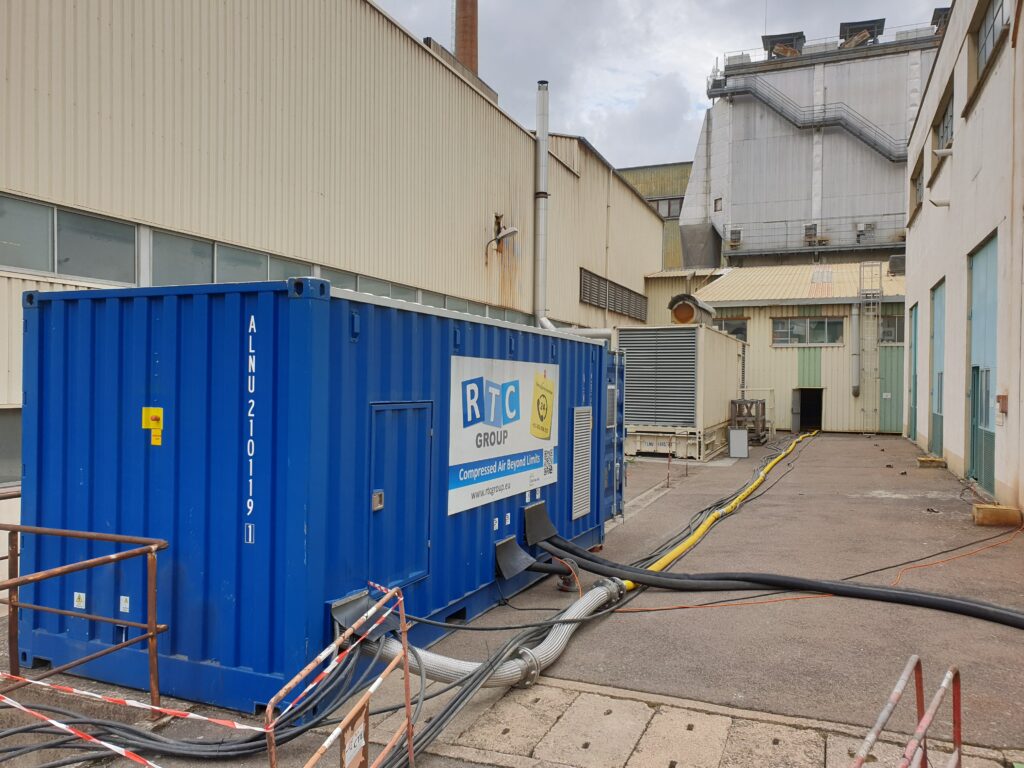
For a short, well-defined production peak where demand is predictable, a single correctly sized machine is usually the preferred choice. It reduces installation complexity, minimises the number of connections to your permanent system, and gives you one point of control. Large centrifugal oil-free compressors, such as those in the rental fleet available through RTC Group’s oil-free compressor rental range, can deliver several thousand m³/h from a single unit, making them well suited to high-demand industrial applications.
Multiple smaller units become the better answer when the peak demand varies significantly across the rental period, when you need built-in redundancy so that one machine failing does not stop production entirely, or when the physical constraints of your site prevent a large machine from being positioned close enough to the connection point. The N+1 principle, where one additional unit is available beyond the minimum required capacity, is standard practice in critical production environments and is equally applicable to temporary rental installations.
The trade-off is coordination: multiple units need multiple power connections, multiple sets of pipework connections, and more installation time. For emergency rentals where speed matters, a single large unit is often faster to deploy.
When should you include a dryer or air receiver in the rental package?
Include a dryer when your process is sensitive to moisture, when pipework or equipment is exposed to freezing temperatures, or when the air quality specification requires a controlled pressure dew point. Include an air receiver when your demand is intermittent or spiky, when you need a buffer to stabilise system pressure, or when the compressor alone cannot respond quickly enough to sudden demand surges.
For most industrial production processes, a refrigerant dryer delivering a pressure dew point of around +3°C is sufficient to prevent condensation in the distribution system. However, processes involving moisture-sensitive materials, outdoor pipework in cold climates, or instrument air systems often require a desiccant dryer capable of reaching dew points of -40°C or lower. The aluminium smelter project in Iceland completed by RTC Group, for instance, required three desiccant dryers delivering a combined 200 m³/min at a -40°C pressure dew point, illustrating how demanding cold-climate and process-critical applications can be.
An air receiver serves a different purpose. It acts as a buffer volume that absorbs short-term demand spikes without forcing the compressor to cycle rapidly or allowing system pressure to collapse during a sudden high-draw event. In a temporary installation where the rental compressor connects at a single point into a large distribution network, a receiver at the connection point helps stabilise pressure across the system. The appropriate receiver volume depends on the size of the demand spikes and the response speed of the compressor.
When in doubt, discuss both options with your rental provider during the sizing conversation. Including a dryer and receiver in the package adds cost and installation time, but the consequences of moisture damage or a pressure collapse during a production peak are typically far more expensive than the additional rental equipment.
How far in advance should you arrange a rental compressor for a production peak?
For a planned production peak, arrange the rental at least four to six weeks in advance. This allows time to complete the technical sizing, confirm equipment availability, arrange any necessary power connections or transformer equipment, and schedule delivery and installation without rushing. For large or complex installations involving medium-voltage connections or multiple units, eight weeks or more is advisable.
The lead time is not just about equipment availability. A proper temporary compressed air installation requires site surveys, engineering design, logistics planning, and coordination with your own maintenance and operations teams. Compressing this timeline increases the risk of errors, delays, and mismatches between the rental equipment and your site infrastructure.
Emergency rentals are a different scenario. When a compressor fails unexpectedly mid-production, the priority is speed. RTC Group maintains 24/7 support availability and positions its rental fleet to respond to urgent industrial needs across Europe. In genuine emergencies, deployment within hours or days is possible, though the scope of what can be engineered and installed safely in that timeframe is naturally more limited than a planned project.
The practical advice is to treat your production peak calendar as a trigger for early rental conversations, even if the exact timing is not yet confirmed. Engaging a rental specialist early costs nothing but gives you the option to plan properly, secure the right equipment, and avoid the premium and risk that comes with last-minute arrangements. You can outline your requirements directly through the RTC Group contact page to start that conversation.