
Maintaining compressed air purity during a planned plant shutdown means replacing your permanent compressor system with a certified temporary oil-free supply before production stops, so that air quality standards are maintained. For industries where contamination is not an option, the temporary system must match the purity class of the equipment it replaces. The questions below address the specific risks, equipment, timing, and standards that determine whether a shutdown goes smoothly or puts production at risk.
What are the biggest compressed air contamination risks during a plant shutdown?
During a planned plant shutdown, the biggest compressed air contamination risks are oil carry-over from non-oil-free temporary equipment, moisture ingress from inadequately dried air, and particulate contamination introduced through poorly maintained or incompatible temporary connections. Any one of these can compromise product quality, damage downstream equipment, or trigger a compliance failure the moment production restarts.
Oil contamination is the most consequential risk. If a temporary compressor uses oil-lubricated compression and downstream filtration rather than a genuinely oil-free compression process, trace oil aerosols can still reach process air lines. In food and beverage or pharmaceutical environments, this creates an immediate hygiene and regulatory problem. In sensitive manufacturing processes, even small quantities of oil can degrade product quality or damage instrumentation.
Moisture is equally damaging. As compressed air cools in distribution pipework, water condenses. Without adequate drying matched to the process requirement, moisture causes corrosion inside pipework, interferes with pneumatic controls, accelerates tool wear, and can freeze in outdoor or exposed sections of the temporary installation. The appropriate dew point for a given application depends on the process and the ambient conditions the pipework passes through.
Particulate contamination is a less obvious but real risk during shutdowns. Temporary connections, hose assemblies, and unfamiliar equipment can introduce debris into a distribution system that has otherwise been kept clean. This is particularly relevant when connecting a temporary supply to existing pipework that may not have been flushed or inspected during the shutdown period itself.
Need Reliable Oil-Free Compressed Air?
Our experts help you find the right compressed air rental solution for your industrial needs.
How does a temporary oil-free compressor maintain air purity standards?
A temporary oil-free compressor maintains air purity standards by producing compressed air through a compression process that contains no oil at any stage, eliminating the risk of oil carry-over into the air stream. When the compressor is paired with appropriate drying and filtration equipment, the delivered air quality can match the purity class required by the process it is temporarily supplying.
The distinction between oil-free and technically oil-free air matters here. Technically oil-free air is produced by oil-lubricated compressors whose output is then treated by downstream filtration to remove oil content. Genuinely oil-free compression uses water or air bearings, or other oil-free mechanisms, so that oil is never introduced into the compression chamber in the first place. For processes requiring the highest air purity, a genuinely oil-free compression process removes the root cause of oil contamination rather than treating its effects.
ISO 8573-1 Class 0 is the most demanding classification within the standard. It describes compressed air with oil content below the detection limit of the measurement method. Equipment capable of delivering air to this specification is the appropriate choice for processes where even trace oil contamination is unacceptable. It is worth noting that ISO 8573-1 Class 0 describes the quality of the air produced, not a certification held by a supplier. The relevant question is whether the temporary equipment and treatment train can deliver air at the required purity class under the actual operating conditions of the installation.
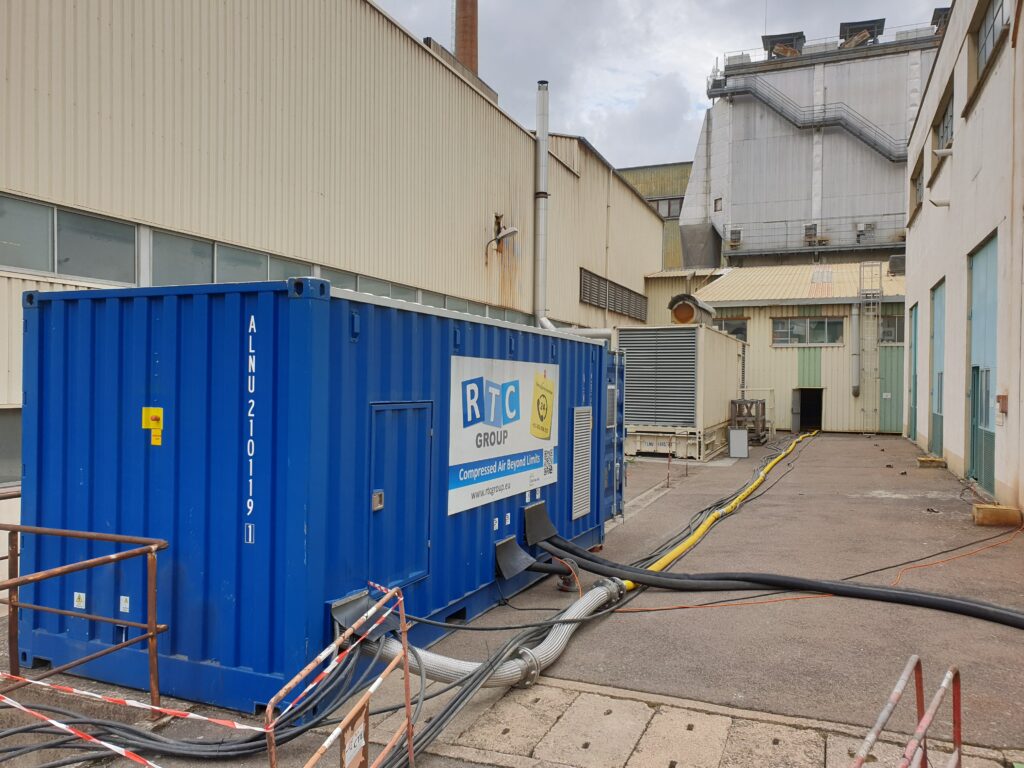
RTC Group operates a fleet of oil-free compressor rentals designed specifically for temporary industrial supply during maintenance, shutdown, and backup duties, covering applications where air purity is a non-negotiable production requirement.
What equipment is needed for a temporary compressed air supply during shutdown?
A complete temporary compressed air supply during a planned shutdown requires, at minimum, an oil-free compressor sized to the demand, an air dryer matched to the required pressure dew point, and appropriate pipework and connections to integrate with the existing distribution system. Depending on the application, the installation may also need air receivers, power supply infrastructure, and redundant equipment to protect against a secondary failure during the shutdown period.
Compression and drying
The compressor must be sized to match the flow rate and pressure the process demands. For large industrial consumers, this may mean centrifugal compressors delivering high volumes continuously. For sites without a suitable mains supply, diesel-powered oil-free compressors provide the same air quality without dependence on grid electricity. Hybrid units that start on diesel and switch to mains power when available are particularly useful during emergency response or in situations where electrical infrastructure is being restored in parallel with the shutdown work.
The dryer specification depends on the process requirement. Refrigerant dryers are suitable for most general industrial applications and deliver a pressure dew point adequate for indoor pipework systems. Where the process demands very dry air, or where pipework is exposed to low ambient temperatures, desiccant dryers are required. Desiccant drying can achieve pressure dew points well below zero, protecting moisture-sensitive processes and preventing condensation in exposed installations. RTC Group has supplied desiccant dryers rated to a minus 40 degrees Celsius pressure dew point in projects across Europe, including a gas separation project in Belgium and a sugar factory project in the Netherlands.
Power supply and redundancy
Power infrastructure is a practical constraint that affects equipment selection. Medium-voltage compressors can connect directly to an existing medium-voltage supply on site, removing the need for large temporary transformers. This simplifies the installation considerably and reduces the civil work required during the shutdown window. Low-voltage units at 400 V are suitable where a compatible supply is available and the power demand is within range.
Redundancy is a critical planning consideration that is often underestimated. The N+1 principle, where one additional compressor is available beyond the operational requirement, protects the temporary installation against equipment failure during the shutdown. If the permanent system is already offline for maintenance, there is no fallback. A redundant temporary compressor provides the same protection during the shutdown period that the standby machine normally provides during regular production. Air receivers add buffer capacity, smoothing demand peaks and providing a short-term supply bridge if a compressor trips.
When should you arrange a temporary compressed air solution before a shutdown?
You should arrange a temporary compressed air solution as early as possible in the shutdown planning process, ideally several weeks before the scheduled outage date. Lead times for large-capacity oil-free equipment, engineering design, logistics, and site preparation mean that late requests risk delivery delays that could push back the shutdown or force a compromise on equipment specification.
The planning window depends on the complexity of the installation. A straightforward single-compressor rental for a short maintenance window may be arranged with a shorter lead time. A multi-machine installation with desiccant drying, medium-voltage connection, redundant equipment, and several hundred metres of electrical cable and pipework requires detailed engineering, equipment reservation, and logistics coordination that cannot be compressed into a few days.
Early engagement also allows the temporary solution to be designed around the actual process requirements rather than whatever equipment happens to be immediately available. Matching flow rate, pressure, dew point, power supply, and purity class to the specific application is a technical exercise that benefits from time. Rushing this process increases the risk of under-specification, which then creates the contamination or capacity problems the temporary installation was meant to prevent.
For planned shutdowns, the full scope of a temporary compressed air project covers system design, equipment selection, logistics, installation, and start-up. Having a single partner manage this entire scope removes coordination risk and gives operations teams a clear point of accountability throughout the shutdown period.
What air purity standards apply during planned industrial shutdowns?
The air purity standards that apply during a planned industrial shutdown are the same standards that apply during normal production. A temporary compressed air supply does not change the regulatory, contractual, or process requirements of the facility it is serving. If the permanent system delivers air to a defined purity class, the temporary replacement must meet the same specification.
ISO 8573-1 is the primary international standard for compressed air quality. It classifies air purity across three contaminant categories: particulates, water, and oil. The classification runs from Class 1 to Class 6 for most categories, with Class 0 representing the most stringent specification, describing air with contaminant levels below the measurable threshold for oil. Different processes require different classes, and the appropriate class for a given application is determined by the sensitivity of the process, the equipment manufacturer’s requirements, and any applicable regulatory framework.
In food and beverage production, pharmaceutical manufacturing, and electronics assembly, the consequences of delivering out-of-specification air during a shutdown are the same as delivering it during normal production. Product contamination, equipment damage, and regulatory non-compliance do not become acceptable simply because the facility is in a maintenance phase. In some cases, the shutdown period involves cleaning, validation, or recommissioning activities that are themselves sensitive to air quality.
For industries such as metal production, chemical processing, and gas separation, the purity requirement is driven by process chemistry and equipment protection rather than hygiene regulation, but the principle is the same. The temporary air supply must be specified to meet the process requirement, not simply to provide air at the right pressure and flow rate.
Selecting a specialist with the technical depth to match equipment to the required purity class, and the fleet to deliver it reliably, is the practical safeguard against a specification gap during the shutdown window. RTC Group’s rental equipment range covers the compressor types, dryer technologies, and ancillary infrastructure needed to support temporary installations across the full range of industrial purity requirements. For time-sensitive situations or to discuss a specific shutdown requirement, getting in touch directly is the fastest route to a matched solution.