
The most reliable way to ensure an uninterrupted compressed air supply during compressor maintenance is to arrange a temporary rental compressor that matches your production requirements before the maintenance window begins. For industries where compressed air is a critical utility, even a short gap in supply can halt production, damage processes, or trigger costly restarts. The sections below address the most common questions operations managers and maintenance engineers ask when planning for compressor downtime.
What options exist for maintaining compressed air supply during planned maintenance?
The primary options for maintaining an uninterrupted compressed air supply during planned maintenance are temporary rental compressors, N+1 redundancy strategies, and cross-connected backup systems. For most industrial facilities, a temporary rental is the most practical and cost-effective solution because it requires no permanent capital investment and can be scaled precisely to the maintenance period.
In practice, industrial plants approach this challenge in several ways:
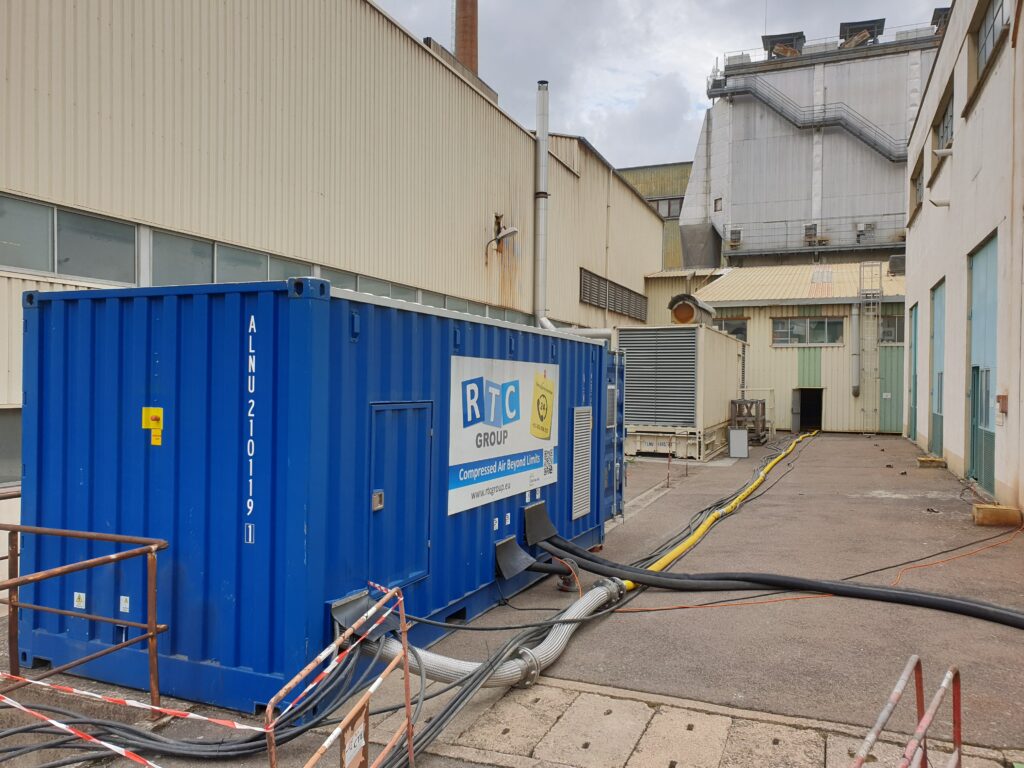
- Temporary rental compressor: A mobile or transportable compressor is brought on-site, connected to the existing distribution system, and commissioned before the primary machine goes offline. This is the most common approach for planned shutdowns and overhauls.
- N+1 redundancy: Some facilities maintain a standby compressor permanently. When that standby unit itself requires maintenance, a rental fills the gap and restores the N+1 configuration. This is particularly relevant in continuous-process industries like steel, aluminium, and chemical production, where losing reserve capacity even temporarily is unacceptable.
- Cross-plant connection: Larger multi-site operations sometimes draw air from an adjacent production area, though this is only viable where the distribution infrastructure and air quality requirements align.
For industries where air purity is non-negotiable, such as food and beverage, pharmaceutical, or PET bottle blowing, a temporary rental must also meet the same purity standards as the permanent installation. A rental that introduces oil contamination into a clean-air system is not a solution at all.
Need Reliable Oil-Free Compressed Air?
Our experts help you find the right compressed air rental solution for your industrial needs.
What is a temporary compressed air rental and how does it work?
A temporary compressed air rental is a short- or medium-term arrangement in which a specialist supplier delivers, installs, and commissions a complete compressed air system at an industrial site for the duration of a maintenance period, shutdown, or capacity gap. The rental covers the compressor itself and, depending on the application, ancillary equipment such as air dryers, receivers, and power connections.
The process typically follows this sequence:
- Technical assessment: The rental provider reviews the site’s flow demand, operating pressure, air purity requirements, available power supply, and connection points.
- Equipment selection: A suitable compressor is chosen from the rental fleet. For sites with an existing medium-voltage supply, a medium-voltage oil-free compressor can connect directly, avoiding the need for a large temporary transformer. For locations without a reliable mains supply, diesel or hybrid units provide full independence.
- Logistics and delivery: The equipment is transported to site and positioned according to the agreed installation plan.
- Installation and commissioning: The supplier connects the temporary system to the plant’s distribution network, completes all safety checks, and starts up the equipment.
- Ongoing support: Throughout the rental period, technical support remains available. At the end of the maintenance window, the equipment is decommissioned and removed.
RTC Group, for example, manages the entire process from initial design through logistics, installation, and start-up, providing a single point of contact throughout. Exploring the full scope of services gives a clearer picture of what a managed temporary installation involves.
How long does compressor maintenance typically take in industrial settings?
In industrial settings, compressor maintenance duration ranges from a few days for routine servicing to several weeks for major overhauls, bearing replacements, or full compressor rebuilds. The exact duration depends on the compressor type, its age, the complexity of the work, and whether parts must be sourced or manufactured to order.
Common maintenance scenarios and their typical timescales include:
- Planned preventive maintenance: Oil changes, filter replacements, and general inspections typically take one to three days. Many facilities schedule these during a weekend or a short planned production pause.
- Major overhaul: Replacing internal components such as bearings, seals, or impellers on a large centrifugal compressor can take two to six weeks, particularly when specialist technicians or OEM parts are involved.
- Unexpected failure repair: Unplanned breakdowns introduce additional uncertainty. Diagnosis, parts procurement, and repair can extend the downtime window significantly, making a temporary rental even more critical.
- Annual shutdown: Many continuous-process plants schedule a full annual shutdown lasting one to four weeks, during which all major equipment is serviced simultaneously. Temporary compressed air supply is almost always required for these events.
Knowing the likely duration in advance allows a rental provider to plan the correct equipment, logistics, and support coverage. For longer maintenance windows, multi-week or multi-month rental terms are standard, and flexible arrangements mean the rental period can be extended if the maintenance takes longer than planned.
What class of air purity is required during temporary compressed air supply?
The required air purity during temporary compressed air supply is determined by the process being served, not by the fact that the supply is temporary. If your permanent installation delivers ISO 8573-1 Class 0 air, the temporary replacement must meet the same standard. Substituting a lower-purity supply, even briefly, risks contaminating downstream equipment, pipework, and products.
ISO 8573-1 is the international standard that defines compressed air purity in terms of particulate content, water content, and oil content. Class 0 represents the most stringent specification for oil content, requiring that the air contains no detectable oil. This matters most in industries where oil contamination would cause direct harm:
- Food and beverage: Compressed air that contacts food products or packaging must be free of oil to meet food safety requirements.
- Pharmaceutical: GMP-compliant processes require sterile, uncontaminated air. Oil contamination can compromise product integrity and regulatory compliance.
- PET bottle blowing: High-pressure air at roughly 35 to 42 bar(g) is forced into heated PET preforms to shape the bottle. Any oil in that air stream would contaminate the interior of the finished bottle.
- Electronics and cleanroom manufacturing: Oil aerosols cause surface contamination that damages sensitive components and assemblies.
It is important to distinguish between the air purity classification and company-level certifications. ISO 8573-1 Class 0 describes the quality of the compressed air itself, not a certification held by a supplier. When renting temporary equipment, confirm that the compressor technology is genuinely oil-free at the compression stage, not simply filtered downstream. True oil-free compressors, such as centrifugal or oil-free screw designs, do not introduce oil into the compression process at all. RTC Group’s oil-free compressor rental fleet is built on this principle, covering both electric and diesel-powered options.
When should you call a compressed air rental provider before maintenance begins?
You should contact a compressed air rental provider as early as possible, and at minimum two to four weeks before a planned maintenance start date. Earlier contact gives the provider time to confirm equipment availability, complete the technical assessment, arrange logistics, and schedule installation without rushing any safety-critical steps.
The lead time required depends on several factors:
- Equipment size and type: Large centrifugal compressors or medium-voltage units require more preparation than smaller portable machines. Confirming availability and transport logistics for heavy equipment takes time.
- Site complexity: If the installation requires power connections, cooling water, or custom pipework, the engineering design phase adds to the preparation timeline.
- Permitting and safety documentation: Industrial sites often require method statements, risk assessments, and permit-to-work approvals before external equipment can be connected. These documents need time to be prepared and reviewed.
- Ancillary equipment: If the temporary system requires desiccant dryers, air receivers, or transformers in addition to the compressor, coordinating the full package takes longer than sourcing a single machine.
For emergency situations where a compressor has already failed, the timeline compresses significantly. Specialist rental providers with 24/7 availability can mobilise equipment rapidly, but even in emergencies, early contact is better. Every hour spent waiting to make the call is an hour that could have been used preparing the installation.
If you are planning scheduled maintenance or want to discuss emergency cover, speaking directly with RTC Group allows you to confirm equipment availability, discuss your specific air demand, and agree on a timeline before your maintenance window opens. Having that conversation early is the single most effective step you can take to protect your production continuity.