
To determine the required airflow and pressure for a rental compressor, start by calculating the total free air delivery your processes consume at peak load, then add a safety margin of around 10 to 20 percent. From there, establish the minimum operating pressure your most demanding end-use requires, account for pressure drop across pipework and treatment equipment, and size accordingly. Getting both figures right before you rent protects production, avoids costly oversizing, and ensures the temporary unit integrates cleanly with your existing infrastructure.
For industrial facilities where compressed air is a production-critical utility, an undersized or incorrectly pressurised rental compressor is not just an inconvenience: it can halt an entire line. The questions below walk through each step of the sizing process, from calculating total demand to deciding how many units to rent.
What happens if you choose a rental compressor with the wrong capacity?
Choosing a rental compressor with the wrong capacity means your facility will either suffer from insufficient air pressure and flow, causing process failures, reduced output quality, and production stoppages, or you will pay to run a grossly oversized unit that wastes energy and inflates rental costs. Neither outcome is acceptable in a time-critical industrial environment.
When a temporary compressor delivers too little airflow, pressure at the point of use drops below the minimum required by pneumatic tools, control systems, or process equipment. In a food production facility, for example, low pressure on packaging lines causes seal failures and rejects. In a steel plant, insufficient air to pneumatic actuators can disrupt rolling mill controls entirely. The damage is immediate and measurable.
Oversizing carries its own risks. A large centrifugal compressor running well below its design flow point can surge, an unstable operating condition that causes mechanical stress and, in severe cases, equipment damage. Beyond mechanical risk, an oversized unit draws more electrical power than necessary and may require transformer capacity your site cannot easily provide. Accurate sizing is not a formality; it is the foundation of a successful temporary compressed air installation.
Need Reliable Oil-Free Compressed Air?
Our experts help you find the right compressed air rental solution for your industrial needs.
How do you calculate the total airflow demand of your facility?
To calculate total airflow demand, list every compressed air consumer in the facility, identify the free air delivery each one requires at its operating pressure, and sum those values. Apply a simultaneity factor to reflect that not all equipment runs at full load at the same time, then add a margin for leakage and future demand. The result is your required free air delivery, typically expressed in m³/h or m³/min.
In practice, the most reliable starting point is your existing compressor nameplate data and any energy audit records. If your permanent compressors are logged, their average and peak output figures give you a real-world baseline. If that data is unavailable, work through each process systematically.
Step one: List all air consumers and their individual flow rates
Go through every piece of equipment connected to the compressed air network: pneumatic cylinders, air-operated valves, blowing stations, instrumentation, cooling systems, and any process-specific uses such as conveying or agitation. For each item, record the manufacturer-stated air consumption at its rated operating pressure. Sum these values to get a theoretical maximum demand.
Step two: Apply a simultaneity factor and leakage allowance
In most industrial plants, not every consumer operates simultaneously at full rated flow. A simultaneity factor (typically between 0.5 and 0.8 depending on the process) reduces the theoretical maximum to a realistic operating figure. On top of this, add a leakage allowance. In older or larger distribution networks, compressed air leakage can account for 20 to 30 percent of total consumption. A temporary rental installation should be sized to cover both real demand and system losses.
Once you have a working figure, add a safety margin of 10 to 20 percent to handle unexpected demand spikes and to give the compressor operating headroom. This final number is your target free air delivery for the rental unit.
How do you determine the correct operating pressure for a rental compressor?
The correct operating pressure for a rental compressor is determined by identifying the highest pressure required by any end-use in the network, then adding enough margin to compensate for pressure drop across pipework, fittings, filters, dryers, and receivers. The compressor discharge pressure must be set high enough that the most demanding consumer still receives adequate pressure at the point of use.
Pressure drop through a temporary installation can be significant. A refrigerant dryer, a filter assembly, flexible hoses, and a run of temporary pipework can together account for 0.5 to 1.5 bar of pressure loss between the compressor outlet and the furthest point of use. If your process requires 7 bar at the machine, and your temporary distribution system loses 1 bar, your rental compressor must deliver at least 8 bar at its outlet.
It is equally important not to set pressure higher than necessary. Every additional bar of discharge pressure increases energy consumption substantially. If different parts of your facility require different pressure levels, consider whether pressure-reducing valves at specific points can allow the main network to run at a lower pressure, reducing both energy use and the specification of the rental unit required.
For applications with very specific pressure requirements (such as PET bottle blowing, which typically demands pressures in the range of 35 to 40 bar), the rental compressor specification is governed entirely by the blowing process, and standard industrial compressors are not suitable. High-pressure oil-free units designed specifically for that duty are required.
What’s the difference between peak demand and average demand in compressed air?
Peak demand is the maximum airflow your facility draws from the compressed air network at any single point in time, while average demand is the mean consumption across a full operating cycle or shift. The difference between these two figures determines how much buffer capacity, in the form of air receivers or compressor headroom, your temporary installation needs to handle demand spikes without pressure drop.
Many industrial processes are inherently cyclical. A packaging line may draw a large pulse of air every few seconds as cylinders actuate simultaneously. A blast furnace tuyere system may have periodic high-demand events tied to process cycles. If a rental compressor is sized only to average demand, it will be unable to meet peak events without the pressure in the network collapsing.
Air receivers play a critical role here. A correctly sized receiver acts as a buffer, storing compressed air during low-demand periods and releasing it during peaks, allowing a smaller compressor to serve a higher peak demand than it could sustain continuously. When specifying a rental installation, always consider receiver volume alongside compressor output, particularly if your peak-to-average demand ratio is high. A temporary installation that includes adequate receiver capacity can often be served by a more economical compressor than one sized purely to meet peak flow.
Should you rent one large compressor or multiple smaller units?
Whether to rent one large compressor or multiple smaller units depends on your required flow, the criticality of continuity, and your site’s power and space constraints. A single large unit is simpler to connect and manage, but multiple smaller units provide redundancy: if one fails, the others continue to supply air. For critical production environments, redundancy almost always justifies the added complexity.
The N+1 principle is standard practice in industrial compressed air engineering: for every unit of compressor capacity required to meet operational demand, one additional unit is held in reserve. In a temporary rental context, this means that if your process requires one compressor at full output, renting two units of that capacity gives you a working machine and a standby. If the operating unit trips or requires attention, production continues uninterrupted.
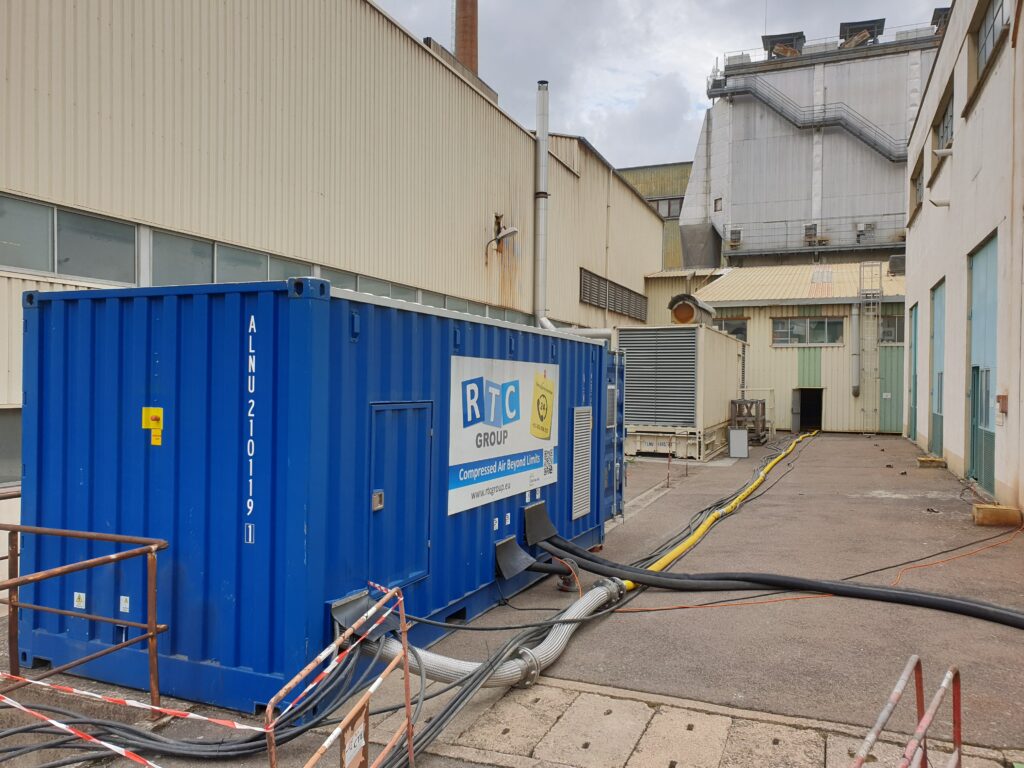
There are also practical reasons to consider multiple units. Very large centrifugal compressors operate at medium voltage (6,000 V in some cases), and connecting them requires the right electrical infrastructure on site. Smaller units operating at 400 V may be easier to integrate into an existing low-voltage supply without transformer upgrades. Conversely, if your site already has a medium-voltage connection, a single large centrifugal unit may be the most efficient and space-saving solution. RTC Group’s rental compressor fleet includes both medium-voltage and low-voltage options precisely because site conditions vary and no single configuration suits every situation.
For very large consumers, aluminium smelters, steel mills, or chemical plants, the required flow may exceed what a single rental unit can deliver, making a multi-compressor installation the only viable option regardless of redundancy considerations.
What information should you provide to a rental compressor supplier?
To receive an accurate rental compressor proposal, provide your supplier with your required airflow in m³/h or m³/min, your required discharge pressure in bar(g), the required air quality class, the available power supply (voltage, phases, and available capacity), the rental duration, and the urgency of the requirement. The more precise this information is, the faster and more accurately a supplier can match equipment to your need.
Beyond the core technical figures, the following details significantly improve the quality of a rental proposal:
- Current compressor data: Nameplate information or energy audit records from your existing machines give a reliable baseline for sizing.
- Reason for rental: Whether you are covering an emergency breakdown, a planned maintenance shutdown, or a capacity expansion affects the equipment configuration and urgency of mobilisation.
- Site access and space: Compressor dimensions, weight, and connection points must be matched to what your site can physically accommodate.
- Air treatment requirements: If your process requires a specific pressure dew point (for example, in pharmaceutical production or any outdoor installation exposed to freezing temperatures), specify this clearly so that the correct dryer type and specification can be included.
- Cooling water availability: Large oil-free centrifugal compressors are water-cooled and require a cooling water supply at a defined flow rate and pressure. If cooling water is not available, air-cooled or alternative configurations must be considered.
- Electrical connection details: Available voltage, the capacity of the supply, and the location of the connection point all affect which compressor models are viable.
A specialist rental supplier will use this information to recommend the right equipment, configure the full installation, including dryers, receivers, and any necessary power infrastructure, and manage delivery and commissioning. RTC Group handles the entire process from initial specification through to installation and start-up, which means the technical sizing work is done in collaboration with the client rather than left entirely to the client’s engineering team. If you are ready to discuss your specific requirements, the RTC Group team is available around the clock to provide a technical assessment and rental proposal.