

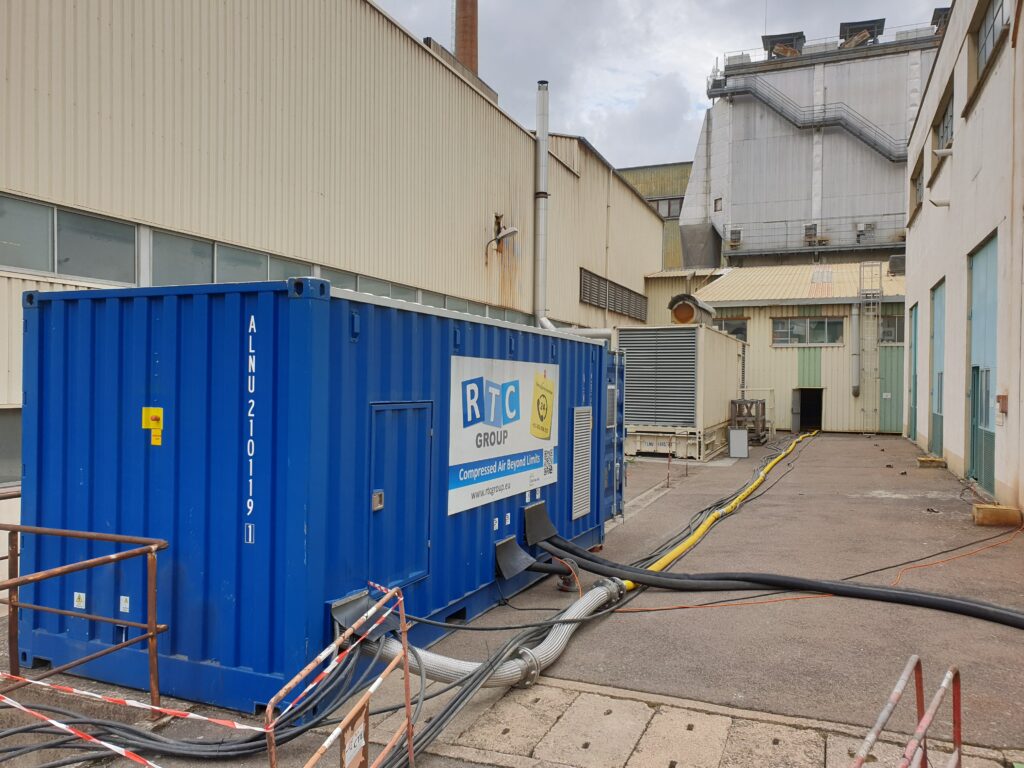
Installing a temporary oil-free compressor requires a reliable electrical power supply matched to the compressor’s motor rating, voltage class, and starting current demands. Most large industrial oil-free compressors operate on either standard 400 V low-voltage or 6,000 V medium-voltage supplies, with motor ratings that commonly range from 250 kW to 700 kW or more depending on the required flow and pressure. The sections below work through the specific electrical questions that plant engineers and procurement managers most often face before a temporary installation goes ahead.
What voltage and amperage does a temporary oil-free compressor typically need?
A temporary oil-free compressor for industrial use typically requires either a 400 V low-voltage or a 6,000 V medium-voltage supply, with current draw determined by the motor’s kilowatt rating. Smaller centrifugal units drawing around 250 kW at 400 V will demand roughly 400 to 450 A at full load, while larger machines rated at 530 kW or 700 kW at the same voltage pull proportionally higher currents. Medium-voltage machines at 6,000 V draw far lower currents for the same power output.
To put this in concrete terms, the fleet operated by RTC Group includes centrifugal oil-free compressors with motor ratings spanning from 250 kW up to 700 kW. A 450 kW unit at 400 V, for example, will draw in the region of 700 to 800 A at full load, which places significant demands on the available switchgear and cable infrastructure at a temporary installation site. A 700 kW machine at 6,000 V, by contrast, draws only around 75 to 80 A, making the cabling task considerably more manageable.
Beyond steady-state running current, the starting current must also be taken into account. Direct-on-line starting of a large compressor motor can produce an inrush current of five to seven times the full-load value for several seconds. Most temporary installations use soft-starters or variable-frequency drives to limit this inrush, but the available supply capacity still needs to be confirmed before the compressor arrives on site.
Need Reliable Oil-Free Compressed Air?
Our experts help you find the right compressed air rental solution for your industrial needs.
What is the difference between low-voltage and medium-voltage compressor connections?
Low-voltage compressors operate at 400 V and connect to standard industrial distribution switchgear, while medium-voltage compressors operate at 6,000 V and connect directly to a site’s medium-voltage busbar or ring main. The practical difference is that low-voltage machines require heavier cabling and larger isolators to carry the higher currents, whereas medium-voltage machines carry lower currents but demand specialist switchgear, certified medium-voltage engineers, and compliance with higher-voltage safety regulations.
For a temporary installation, this distinction has a direct impact on logistics and cost. A low-voltage compressor rated at 530 kW needs a 630 A or 800 A isolator, substantial copper or aluminium cabling, and a corresponding low-voltage distribution panel. If the site’s existing low-voltage infrastructure cannot support that load, a temporary transformer is required to step down from the medium-voltage network, adding equipment, space, and cost.
A medium-voltage compressor sidesteps this problem entirely by connecting directly to the site’s 6,000 V or 10,000 V network. RTC Group offers medium-voltage oil-free compressors as a rental solution that is unique in Europe precisely because it eliminates the need for large temporary transformers on sites that already have medium-voltage infrastructure available. For steel mills, aluminium smelters, chemical plants, and other heavy industrial facilities that routinely operate medium-voltage distribution systems, this is often the faster and more cost-effective connection route.
Does a temporary oil-free compressor always need a power transformer?
No. A temporary oil-free compressor does not always need a power transformer. Whether a transformer is required depends entirely on whether the site’s available voltage matches the compressor’s motor voltage. If a site has a 400 V low-voltage supply with sufficient capacity and a medium-voltage compressor is not being used, no transformer is needed. A transformer becomes necessary only when the available supply voltage does not match the compressor’s rated voltage, or when the existing low-voltage infrastructure cannot carry the required load.
The most common scenario requiring a temporary transformer is when a large low-voltage compressor is deployed at a site where the nearest suitable connection point is a medium-voltage feeder. In that case, a step-down transformer (typically 630 kVA to 1,600 kVA for large industrial compressors) must be brought in alongside the compressor itself. RTC Group handles this as part of its end-to-end project delivery, supplying transformers, cabling, switchgear, and all ancillary equipment as a single managed package.
Choosing a medium-voltage compressor where the site already has medium-voltage distribution available is one straightforward way to avoid the transformer requirement altogether. This reduces the number of equipment items on site, shortens installation time, and lowers the overall cost of the temporary compressed air supply.
How does a diesel or hybrid oil-free compressor change the power equation?
A diesel oil-free compressor requires no electrical connection at all, running entirely on its own onboard fuel supply. A hybrid oil-free compressor starts on diesel power and switches to mains electricity when a suitable supply becomes available. Both options fundamentally change the power equation for temporary installations by removing or reducing dependence on the site’s electrical infrastructure during the critical early phase of deployment.
For sites where electrical power is unavailable, interrupted, or delayed, such as during an emergency plant shutdown, a transformer failure, or a greenfield installation where grid connection has not yet been established, a diesel or hybrid unit can deliver Class 0 oil-free compressed air immediately, without waiting for electrical work to be completed.
The hybrid option is particularly practical for situations where mains power is expected but not yet live. The compressor arrives, starts on diesel, and keeps production going. When the electrical connection is ready, it transfers to mains supply without interrupting the compressed air output. This approach is well suited to emergency response scenarios and planned maintenance outages where the timeline for restoring grid power is uncertain. Fuel consumption for large diesel oil-free compressors running at full load is substantial, so the hybrid’s ability to transition to mains power as soon as it is available also has a meaningful impact on operating cost over a longer rental period.
What site preparations are needed before a temporary compressor is connected?
Before a temporary oil-free compressor can be connected and started, the site must be able to provide a confirmed power supply of the correct voltage and sufficient capacity, a stable and level foundation or hardstanding area for the compressor and ancillary equipment, accessible cable routes from the connection point to the machine, and adequate cooling water supply for water-cooled centrifugal machines. These preparations must be completed or verified before delivery to avoid delays on site.
The specific preparation steps depend on the compressor type and size, but the following are consistently relevant for large industrial temporary installations:
- Electrical supply confirmation: The available voltage, maximum available current, and short-circuit capacity at the proposed connection point must be confirmed with the site’s electrical team or network operator before equipment selection is finalised.
- Isolator and protection coordination: The site’s upstream protection must be coordinated with the compressor’s starting characteristics to prevent nuisance tripping during start-up.
- Cable routing and sizing: Temporary cabling from the supply point to the compressor must be sized for the full-load current with appropriate derating for ambient temperature and laying conditions.
- Cooling water availability: Water-cooled centrifugal compressors require a continuous cooling water supply at the correct flow rate and pressure. For example, a large centrifugal unit may require 750 litres per minute at 2 to 5 bar; this must be available and connected before start-up.
- Space and access: The compressor, air dryer, air receiver, and any transformer must all fit within the allocated area, with sufficient clearance for maintenance access and safe operation.
- Compressed air pipework connection: The outlet connection point and pipe diameter must match the compressor’s outlet flange specification, and the pipework must be rated for the operating pressure.
Addressing these points before the equipment arrives on site is the single most effective way to keep a temporary installation on schedule. RTC Group’s engineering team carries out a site assessment as part of the project preparation process, working through each of these requirements with the client’s technical team in advance of delivery.
Who is responsible for the electrical installation of a rented compressor?
Responsibility for the electrical installation of a rented compressor depends on the scope agreed in the rental contract, but for a fully managed temporary compressed air supply, the rental specialist handles all electrical connection work using certified engineers. This includes cable installation, transformer connection if required, protection coordination, and commissioning. The site operator remains responsible for providing a confirmed and safe connection point that meets the agreed specification.
When working with a specialist supplier such as RTC Group, the division of responsibility is clearly defined from the outset. RTC Group holds the certifications required for medium- and high-voltage installation work (including NEN 3840 for medium- and high-voltage installations and NEN 3140 for low-voltage work) and carries out all connection and start-up activities with its own certified personnel. This means the client does not need to source separate electrical contractors or coordinate between multiple parties.
For the site operator, the practical obligation is to ensure that the agreed connection point is available, isolated, and safe for the rental supplier’s engineers to work on. Any modifications to the site’s permanent electrical infrastructure (such as extending a busbar, installing a new incoming feeder, or upgrading a substation) remain the responsibility of the site owner and their appointed contractors. These works need to be completed and signed off before the temporary compressor installation can proceed.
If you are planning a temporary compressed air installation and need to confirm what electrical preparation is required at your site, contact RTC Group’s team directly. A technical assessment of your site’s power infrastructure is part of the project preparation process, and the engineering team can advise on the most practical connection route for your specific situation. You can also review the available compressor fleet to identify the voltage class and power rating that best matches your production requirements.