

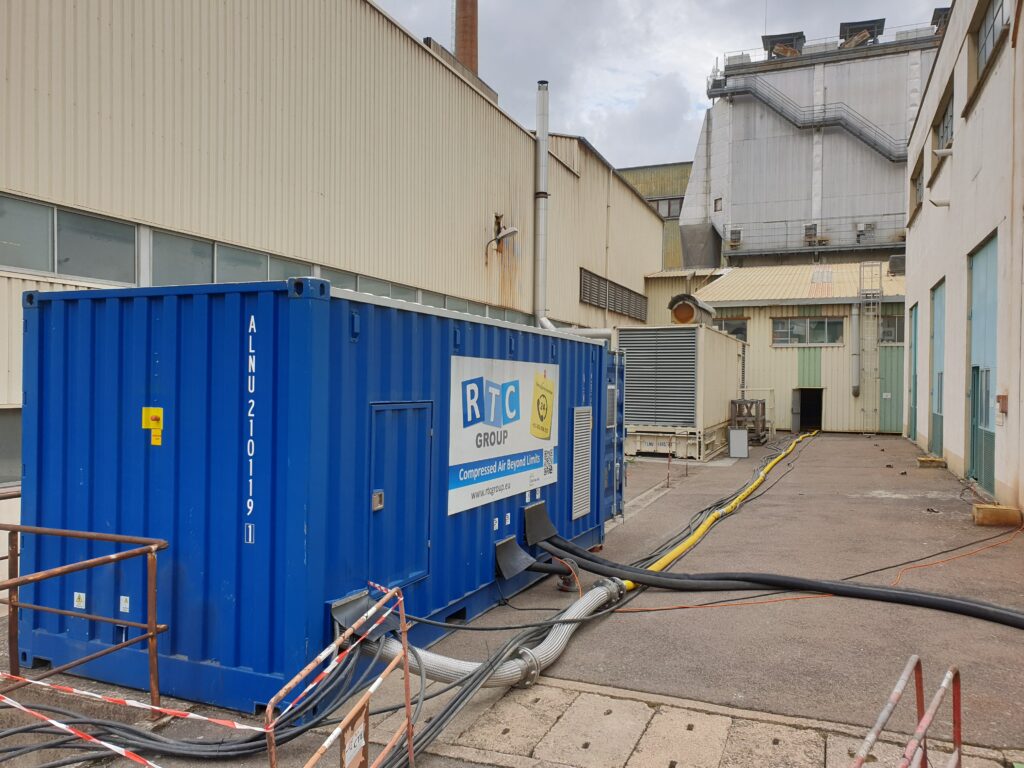
A compressed air system failure can halt industrial production within seconds. For most manufacturing processes, compressed air is not a utility that can be temporarily bypassed: it is an active part of the production line, and when supply drops or stops, so does output. The sections below address the most critical questions operations managers and maintenance engineers face when a compressor breakdown occurs or threatens to occur.
How quickly does a compressed air failure shut down production?
In most industrial facilities, a compressed air system failure causes production to stop within seconds to minutes. Compressed air powers pneumatic actuators, control valves, conveying systems, and process tools that cannot operate without a continuous supply at the correct pressure. Once pressure falls below the minimum threshold, downstream equipment trips on safety interlocks or simply ceases to function.
The speed of shutdown depends on how much stored capacity exists in the system. A large air receiver can buffer a sudden drop in compressor output for a short period, buying time to investigate the fault. However, in high-consumption facilities such as steel plants, aluminium smelters, or PET bottle blowing lines, that buffer is typically measured in minutes rather than hours. Once it is exhausted, the effect is immediate and total.
For industries where compressed air is tied directly to a continuous process (glass melting, chemical reactions, gas separation), even a brief interruption can cause damage beyond the lost production itself, including spoiled batches, equipment damage from uncontrolled cooling or pressure loss, and lengthy restart procedures.
Need Reliable Oil-Free Compressed Air?
Our experts help you find the right compressed air rental solution for your industrial needs.
What are the most common causes of industrial compressor failure?
The most common causes of industrial compressor failure are inadequate maintenance, cooling system faults, electrical supply problems, and component wear in bearings, seals, or valves. In most cases, failures are not sudden and unpredictable: they develop from conditions that were present for some time before the breakdown occurred.
Mechanical and thermal causes
Overheating is one of the leading triggers of compressor shutdown. When cooling water flow is restricted, ambient temperatures in the compressor room rise, or heat exchangers become fouled, the machine reaches its thermal limit and trips. Bearing wear, lubrication failures in oil-injected machines, and valve deterioration are also frequent contributors, particularly in equipment running at high duty cycles without adequate inspection intervals.
Electrical and control system causes
Voltage fluctuations, phase imbalances, and control system faults account for a significant share of unplanned stoppages. Modern compressors rely on sophisticated electronic control units; a sensor fault, a software error, or a corrupted parameter can shut a machine down even when the mechanical components are in good condition. Electrical supply quality is especially relevant for large centrifugal compressors operating at medium voltage.
Operational and maintenance causes
Deferred maintenance is a systemic risk. Filters that are not replaced on schedule restrict airflow, raise differential pressure, and force the compressor to work harder. Air leaks in the distribution network increase demand beyond the compressor’s capacity, causing it to run continuously at full load and accelerating wear. Inadequate pressure dew point management can allow moisture to accumulate in the system, damaging downstream equipment and, in oil-free applications, compromising air quality.
What does compressed air downtime actually cost a manufacturer?
Compressed air downtime costs a manufacturer through lost production output, wasted materials, idle labour, and the cascading effects of a disrupted production schedule. In continuous process industries, the financial impact of even a few hours of unplanned stoppage can reach tens of thousands of euros, and in some cases significantly more, depending on the facility’s output value and restart complexity.
The direct cost of lost production is the most visible element, but it is rarely the only one. When a production line stops unexpectedly, materials already in process may be scrapped. In food and beverage or pharmaceutical manufacturing, an entire batch may need to be discarded if air supply is interrupted mid-process. In industries with strict hygiene or sterility requirements, the line must also be re-validated before restart, adding hours to the recovery time.
Indirect costs compound the direct losses. Customer commitments are missed, penalty clauses in supply contracts may be triggered, and the reputational damage from delivery failures can affect future orders. Emergency repair costs (premium pricing for out-of-hours engineering, expedited parts shipping, and unplanned contractor fees) add further to the total. When the full cost picture is assembled, the case for investing in redundancy and rapid response capability becomes straightforward.
How do industries with strict air purity requirements handle a compressor failure?
Industries with strict air purity requirements, including food and beverage, pharmaceutical, electronics, and chemical production, cannot simply substitute any available compressor when their primary unit fails. They must restore supply using equipment that delivers air meeting the same purity specification as the failed machine, which means oil-free compression technology is a non-negotiable requirement, not an option.
In these sectors, a failure of the primary compressor exposes a fundamental risk: if the standby or replacement machine does not deliver the same air quality, the production process itself becomes non-compliant. Oil contamination in a food production line, for example, can result in product recalls, regulatory action, and facility shutdowns far more costly than the original compressor failure. For pharmaceutical manufacturers, GMP compliance depends on the integrity of every utility, including compressed air.
The practical response in purity-critical industries is to maintain a redundancy strategy based on the N+1 principle: alongside the compressors needed to meet operational demand, at least one additional compressor is kept available so that any single failure does not interrupt supply. When that standby unit itself fails or requires maintenance, the redundancy is gone, and this is precisely the situation where temporary rental of a certified oil-free compressor restores the safety margin. Oil-free compressor rental allows a facility to reinstate its N+1 buffer without committing to a capital purchase, keeping both production and compliance intact.
Air dryer selection is equally important in these scenarios. A desiccant dryer delivering a pressure dew point of -40°C is standard in moisture-sensitive pharmaceutical and electronics applications. A temporary replacement installation must include compatible drying equipment, not just the compressor itself, to maintain the required air quality throughout the rental period.
What is the fastest way to restore compressed air supply after a breakdown?
The fastest way to restore compressed air supply after a breakdown is to deploy a temporary rental compressor that can be connected to the existing distribution system with minimal site preparation. When an on-site repair will take hours or days, waiting for the permanent machine to be fixed is rarely an acceptable option in a production environment. A pre-mobilised rental unit can restore supply far more quickly than sourcing and installing a replacement compressor.
Speed of response depends on several factors: the availability of rental equipment in the right capacity and voltage class, the distance from the supplier’s depot to the site, and the complexity of the connection. Diesel-powered oil-free compressors offer the fastest deployment in situations where electrical connection is not immediately possible: they arrive ready to run and do not require transformer or switchgear work before they can be started. For sites with medium voltage infrastructure, a medium voltage compressor eliminates the need for a large temporary transformer, which can significantly reduce installation time.
A supplier capable of managing the entire temporary installation (compressor, dryers, receivers, cabling, and commissioning) removes the coordination burden from the facility’s own team at exactly the moment when internal resources are most stretched. RTC Group handles logistics, installation, and start-up in-house, operating with 24/7 availability to support emergency response across Europe. Projects have included deployments at steel plants in Finland and Poland, aluminium smelters in Iceland, food factories in the Netherlands, and chemical plants in Germany, each requiring a complete temporary compressed air system to be operational as quickly as possible.
How can industrial facilities prevent unplanned compressor downtime?
Industrial facilities can prevent most unplanned compressor downtime through structured preventive maintenance, condition monitoring, proper system design, and maintaining genuine redundancy in their compressed air infrastructure. No single measure eliminates risk entirely, but combining these approaches reduces the probability and severity of unexpected failures significantly.
Preventive maintenance and condition monitoring
A disciplined maintenance programme that follows manufacturer service intervals (covering filter replacement, oil changes in oil-injected machines, bearing inspections, valve checks, and heat exchanger cleaning) addresses the most common failure causes before they become critical. Condition monitoring adds a further layer: tracking vibration, temperature, pressure differentials, and power consumption over time allows maintenance teams to identify deteriorating components and schedule intervention before failure occurs. Compressed air leaks in the distribution network should be surveyed and repaired regularly, as they increase system demand and force compressors to run harder than necessary.
Redundancy and contingency planning
The N+1 redundancy principle is the most reliable structural safeguard against production-stopping failures. Operating with at least one compressor in reserve means that a single machine failure does not immediately become a production crisis. However, redundancy only functions if the standby equipment is maintained in a ready-to-run condition. When a standby compressor itself requires repair or scheduled overhaul, the facility loses its buffer, and this is the moment when a temporary rental unit provides the most direct value, restoring the redundancy margin while permanent repairs are completed.
Contingency planning should extend beyond the compressor itself to include dryers, receivers, and distribution components. A failure in any part of the compressed air system can be just as disruptive as a compressor breakdown. Facilities that have a pre-agreed emergency rental arrangement in place (knowing exactly which supplier to call, what equipment is available, and how quickly it can be on site) recover faster than those making those decisions under pressure. Reviewing the available rental equipment and understanding the deployment options before an emergency occurs is a practical step that operations and maintenance managers can take now, rather than after a breakdown has already started.