
Selecting the right oil-free compressor capacity for an industrial facility comes down to accurately calculating your total compressed air demand, matching that demand to the correct flow rate and operating pressure, and then choosing equipment that meets your air purity requirements. Get any one of these three variables wrong and you risk either starving your process of air or paying for capacity you never use. The sections below walk through each decision point in sequence, from demand assessment to rental solutions for capacity gaps.
What factors determine the compressed air demand of an industrial facility?
The compressed air demand of an industrial facility is determined by the sum of all air-consuming equipment operating simultaneously, adjusted for load cycles, system leakage, and a safety margin for future growth. No single number defines demand in isolation. You need to account for every end-use point, how often each one runs, and how much air it consumes at peak and average load.
The most important factors to assess are:
- Connected load: The total theoretical air consumption of all tools, actuators, instruments, and process equipment connected to the system.
- Simultaneous use factor: In most facilities, not every consumer runs at full load at the same time. A realistic simultaneity factor reduces the connected load to an actual operating demand.
- Leakage: Unmanaged compressed air leakage in industrial networks commonly accounts for a significant share of total consumption. Older or poorly maintained distribution systems can waste a substantial portion of generated air before it reaches any productive end use.
- Process peaks: Batch processes, automated production cycles, and start-up sequences create demand spikes that the system must handle without pressure drop.
- Ambient and operational conditions: Temperature, altitude, and inlet air quality affect compressor output. A machine rated at a specific flow rate at sea level and standard temperature will deliver less under hot or high-altitude conditions.
For industries where air purity is non-negotiable, such as food and beverage production or pharmaceutical manufacturing, the demand calculation must also account for air dryers, filters, and ancillary treatment equipment, all of which consume compressed air themselves. Skipping these auxiliary loads leads to systematic undersizing.
Need Reliable Oil-Free Compressed Air?
Our experts help you find the right compressed air rental solution for your industrial needs.
How do you calculate the right compressor capacity in m³/min or CFM?
To calculate the right compressor capacity, add up the air consumption of all connected equipment in m³/min or CFM, apply a simultaneity factor to reflect real operating conditions, add an allowance for system leakage, and include a margin of typically 10 to 25 percent for demand growth and contingency. The result is your minimum required free-air delivery at the system’s working pressure.
A practical approach follows these steps:
- List all consumers with their individual air consumption in m³/min or CFM and their duty cycle (the proportion of time each runs at full load).
- Apply the simultaneity factor to each consumer or group of consumers to arrive at a realistic concurrent demand.
- Add leakage allowance: If the distribution network has not been recently audited, a conservative allowance is appropriate. A well-maintained system may lose less; an older network may lose considerably more.
- Add a contingency margin of 10 to 25 percent to cover measurement uncertainty, undocumented consumers, and near-term capacity growth.
- Confirm the required delivery pressure separately, since compressor flow ratings are pressure-dependent. A machine rated at 8 bar(g) delivers less free air if your system actually operates at a higher pressure.
For large industrial consumers, the numbers scale quickly. To illustrate the range available in practice, RTC Group’s rental fleet includes water-cooled oil-free centrifugal compressors such as the C43-400-18 at around 2,580 m³/h and the C80-400-17 at around 5,300 m³/h, up to larger units in the 6,200 m³/h range. These figures give a sense of the capacity bands relevant to medium and large industrial facilities. Exact selection always requires engineering confirmation against your specific site conditions and current fleet availability, which is why working with a specialist rather than selecting from a catalogue alone is essential.
What’s the difference between flow rate, pressure, and air quality in compressor selection?
Flow rate, pressure, and air quality are three independent parameters in compressor selection, and each one must be matched to the process requirement separately. Flow rate defines how much air the compressor delivers per unit of time. Pressure defines the force at which that air is delivered. Air quality defines the purity of the air in terms of oil content, moisture, and particulates. A compressor that gets two of these right but fails on the third is the wrong compressor for the application.
Flow rate and pressure
Flow rate is expressed in m³/min, m³/h, or CFM and represents the volume of free air the compressor can supply continuously at its rated discharge pressure. Pressure is expressed in bar(g) or psi and must match the highest-pressure consumer in the system, with allowance for distribution losses. These two parameters interact: a compressor delivers its rated flow only at its rated pressure. If your system pressure is higher than the machine’s design point, actual delivered flow will be lower.
Air quality
Air quality is defined by ISO 8573-1, which classifies compressed air by its content of solid particles, water, and oil. Class 0 under this standard represents the most stringent air purity level, specifying that oil content is below the detection threshold of the measurement method. This classification applies to the quality of the air delivered, not to a supplier’s credentials. For processes in food production, pharmaceuticals, electronics, or any application where oil contamination would compromise the product or the process, Class 0 air quality is the appropriate target. Oil-injected compressors, even with downstream filtration, carry a residual contamination risk that oil-free machines eliminate by design. Matching the correct air quality class to your process is as important as matching flow and pressure.
When should an industrial facility choose oil-free over oil-injected compression?
An industrial facility should choose oil-free compression whenever oil contamination in the compressed air would damage the product, compromise a process, or create a regulatory compliance problem. In oil-injected compressors, lubricating oil is present in the compression chamber and, despite downstream filtration, a residual risk of oil carry-over remains. Oil-free compressors eliminate oil from the compression stage entirely, removing that risk at source.
The clearest cases for oil-free selection are:
- Food and beverage production: Air that contacts food, packaging, or processing equipment must be free of oil to prevent contamination and meet food safety standards.
- Pharmaceutical manufacturing: GMP-compliant processes require sterile, uncontaminated air. Oil in the air stream can invalidate a batch or trigger a regulatory finding.
- PET bottle blowing: High-pressure air is blown directly into the preform to shape the bottle. Oil contamination at this stage would render the bottles unusable.
- Electronics and cleanroom environments: Even trace oil aerosols can damage sensitive components or disrupt precision processes.
- Metal processing: In aluminium and steel production, compressed air is used for instrumentation, pneumatic control systems, and process cooling. Oil contamination in these systems can cause equipment malfunction and costly unplanned downtime.
Beyond contamination risk, oil-free compression also eliminates the ongoing cost and logistics of oil changes, oil disposal, and coalescing filter maintenance, which can be a practical operational argument even in applications where contamination risk is low but maintenance simplicity is valued.
How does a rental oil-free compressor solve a capacity gap or emergency situation?
A rental oil-free compressor solves a capacity gap or emergency by providing certified, immediately deployable compressed air capacity without the capital commitment, lead time, or installation complexity of a permanent machine. When a production facility loses a compressor to an unexpected failure, or when a planned maintenance shutdown requires the permanent system to be taken offline, a rental unit can bridge the gap and keep production running.
The most common situations where rental capacity is the right answer include:
- Unplanned compressor failure: A critical machine breaks down mid-production. Waiting weeks for a replacement or repair is not an option. A rental unit can be mobilised rapidly to restore air supply.
- Failure of standby capacity: Many facilities operate on an N+1 principle, where one spare compressor is kept available to cover any single failure. If that standby unit fails before the primary is repaired, the redundancy is gone. A rental compressor restores the safety margin while the standby is serviced.
- Planned maintenance and overhaul: Scheduled shutdowns for compressor servicing, pipework modifications, or facility upgrades require temporary air supply to keep adjacent processes operational.
- Capacity expansion during transition: When a facility is commissioning new equipment or expanding production before permanent compressed air infrastructure is in place, a rental unit covers the interim demand.
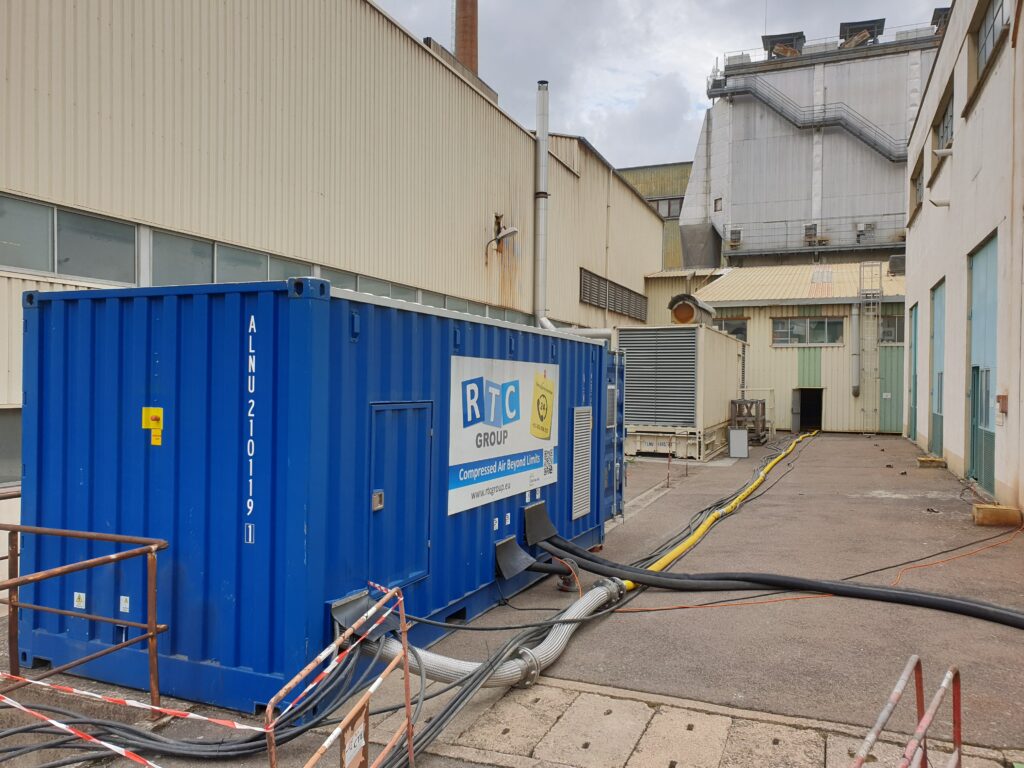
RTC Group operates Europe’s largest centrifugal oil-free compressor rental fleet, with units ranging from smaller centrifugal machines to large-capacity models exceeding 6,000 m³/h. The rental service covers not just the compressor itself but the complete temporary installation, including air dryers, air receivers, power transformers where needed, and all logistics, delivery, and commissioning. For sites without a stable mains power supply, diesel and hybrid units are available, with the hybrid option starting on diesel and switching to mains electricity when a connection becomes available. You can review the full range of available equipment at RTC Group’s equipment pages or contact the team directly to discuss your specific capacity requirements and timeline.