
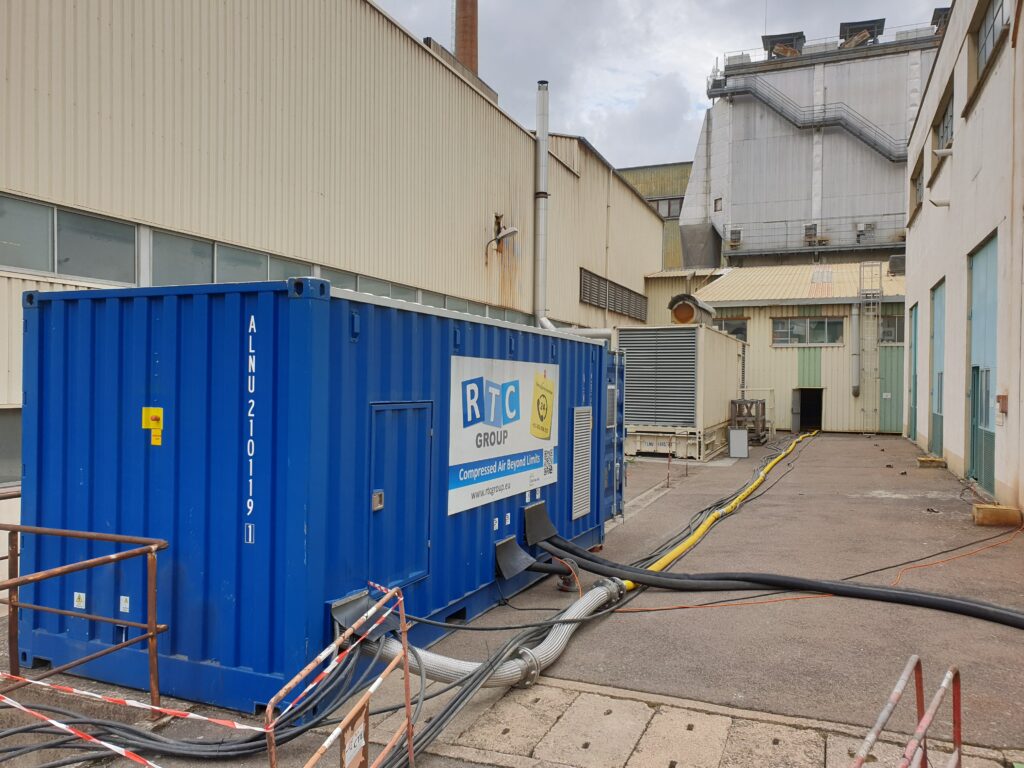
An industrial oil-free compressor rental requires more than the compressor unit itself. A complete temporary compressed air installation typically includes air dryers, air receivers, electrical infrastructure such as transformers or cabling, and associated pipework and controls, all sized and configured to match the specific production process and site conditions. The exact combination depends on air quality requirements, available power supply, and whether the rental unit is electrically driven or diesel-powered. The sections below address each component in turn, from dryer selection through to who is responsible for delivering and installing the full system.
What types of air dryers are needed with a rented oil-free compressor?
A rented oil-free compressor almost always requires an air dryer to remove moisture from the compressed air before it reaches the process. The two main types used in industrial compressed air rental are refrigerant dryers and desiccant dryers. The right choice depends on the dew point your application demands and whether any part of the installation is exposed to freezing temperatures.
Refrigerant dryers
Refrigerant dryers work by cooling the compressed air so that water vapour condenses and can be separated and drained away. They are well suited to general industrial drying duties where a moderate pressure dew point is acceptable. For most production environments operating in controlled indoor conditions, a refrigerant dryer paired with an oil-free compressor delivers clean, dry air without the complexity or energy demand of more advanced drying technology.
Desiccant dryers
Desiccant dryers use an adsorbent material to pull moisture out of the compressed air, achieving significantly lower pressure dew points than refrigerant technology can reach. They are the correct choice for moisture-sensitive processes, outdoor pipework exposed to sub-zero temperatures, and applications in industries such as pharmaceuticals or electronics where even trace humidity creates quality or safety risks. In a real-world example from RTC Group’s project history, an aluminium smelter installation in Iceland required three desiccant dryers providing 200 m³/min at a pressure dew point of minus 40 degrees Celsius, conditions that a refrigerant dryer simply cannot meet.
When specifying dryers for a temporary compressed air supply, the dryer capacity must be matched to the compressor’s flow rate. Undersizing a dryer is a common planning error that results in elevated dew points and potential process contamination, even when the compressor itself is performing correctly.
Need Reliable Oil-Free Compressed Air?
Our experts help you find the right compressed air rental solution for your industrial needs.
Why are air receivers necessary in a temporary compressed air installation?
Air receivers are necessary in a temporary compressed air installation because they buffer the system against demand fluctuations, stabilise network pressure, and protect downstream equipment from pressure spikes. Without adequate receiver volume, even a correctly sized compressor will struggle to maintain stable pressure when consumption varies, and in industrial processes, pressure instability directly affects product quality and machine performance.
In a temporary installation, receivers serve an additional practical function: they act as a separation point between the compressor and the distribution network, giving condensed moisture a place to collect and drain before the air moves further downstream. This is particularly important when the installation includes long pipe runs or when the compressed air is being fed into an existing plant network that was not designed for the flow characteristics of the temporary unit.
Receiver sizing is determined by the compressor’s output, the variability of demand, and the acceptable pressure band for the process. For large-scale temporary installations, a single large air header vessel is often used rather than multiple smaller tanks. The Iceland aluminium smelter project referenced above included a 10,000-litre air header as part of the complete system package, illustrating that receiver specification is an engineering decision, not an afterthought.
What electrical infrastructure is required to power a rented oil-free compressor?
The electrical infrastructure required depends on whether the compressor operates on low voltage (typically 400 V) or medium voltage (typically 6,000 V or higher). Large oil-free centrifugal compressors frequently require medium-voltage supplies, which means the site must either have a compatible medium-voltage connection point or a temporary transformer must be installed to step voltage down to the compressor’s operating level.
Low-voltage installations
Low-voltage oil-free compressors operating at 400 V connect to a standard industrial supply, but the available supply capacity must still be verified before rental equipment arrives on site. A compressor drawing 350 to 530 kW (typical for mid-range centrifugal units in RTC Group’s fleet) places a substantial load on the local electrical infrastructure. Cable sizing, protection devices, and connection points all need to be confirmed as part of the pre-installation engineering process.
Medium-voltage installations
Medium-voltage oil-free compressors can connect directly to an existing compatible medium-voltage supply, which eliminates the need for a large temporary transformer and simplifies the overall installation. This is a technically significant advantage in situations where low-voltage transformer capacity is limited or where the site’s existing infrastructure already operates at medium voltage. However, this is not a plug-and-play arrangement: protection schemes, auxiliary supplies, and site compatibility require an engineered design and qualified electrical personnel for safe commissioning. Where a transformer is needed, it becomes part of the ancillary equipment package alongside the compressor and dryers. You can review the full range of rental equipment available, including transformers, on the RTC Group equipment pages.
How does ancillary equipment differ for diesel oil-free compressor rentals?
Diesel oil-free compressor rentals remove the requirement for electrical power infrastructure entirely, but they introduce a different set of ancillary considerations. Because the compressor generates its own power through an onboard diesel engine, there is no need for a transformer or high-capacity electrical cabling, making diesel units the practical choice for sites without a suitable mains supply or where connecting to the grid would take too long to arrange.
The ancillary equipment that remains constant regardless of power source includes air dryers, air receivers, and the pipework connecting the compressor to the process. Desiccant dryers are particularly common with diesel oil-free rentals used in outdoor or remote environments, where both moisture control and freeze protection are priorities.
Fuel supply and management become an operational consideration unique to diesel installations. For extended rentals, a reliable fuel delivery schedule must be established, and the compressor’s fuel consumption factored into the overall project cost. Diesel units are also used as standby machines alongside electrically driven primary compressors, providing backup capacity when grid power is unavailable or unreliable.
RTC Group also offers hybrid oil-free compressors, a GenAir innovation that starts on diesel power and switches seamlessly to mains electricity once a grid connection becomes available. For emergency response situations or sites where power infrastructure is being installed in parallel with production, the hybrid unit reduces diesel consumption and operating costs as the project progresses, without requiring a separate machine changeover.
Who is responsible for supplying and installing ancillary equipment in a rental?
In a fully managed compressed air rental, the rental supplier is responsible for supplying, delivering, and installing all ancillary equipment as part of a complete temporary installation. This includes air dryers, receivers, transformers, pipework, and any other components needed to make the system operational. The client’s responsibility is to ensure that the agreed site conditions (power supply, water supply for water-cooled units, access routes, and connection points) are available and ready when the equipment arrives.
This turnkey approach matters because the individual components of a temporary compressed air system must be engineered to work together. A compressor, dryer, and receiver that are each correctly specified in isolation can still underperform if the system design connecting them is inadequate. A specialist rental supplier takes ownership of the complete installation, from initial system design through logistics, installation, and start-up commissioning.
RTC Group operates on exactly this model. The company handles the entire temporary compressed air supply from start to finish, including all equipment, engineering, logistics, and installation, with a single point of contact available around the clock. This is particularly important in emergency situations, where the speed of mobilisation and the technical competence of the installation team directly determine how quickly production can resume. For projects requiring this level of managed support, contacting RTC Group directly is the most efficient way to scope the full ancillary equipment requirement and confirm availability. You can also learn more about how RTC Group approaches temporary compressed air projects before making an enquiry.