

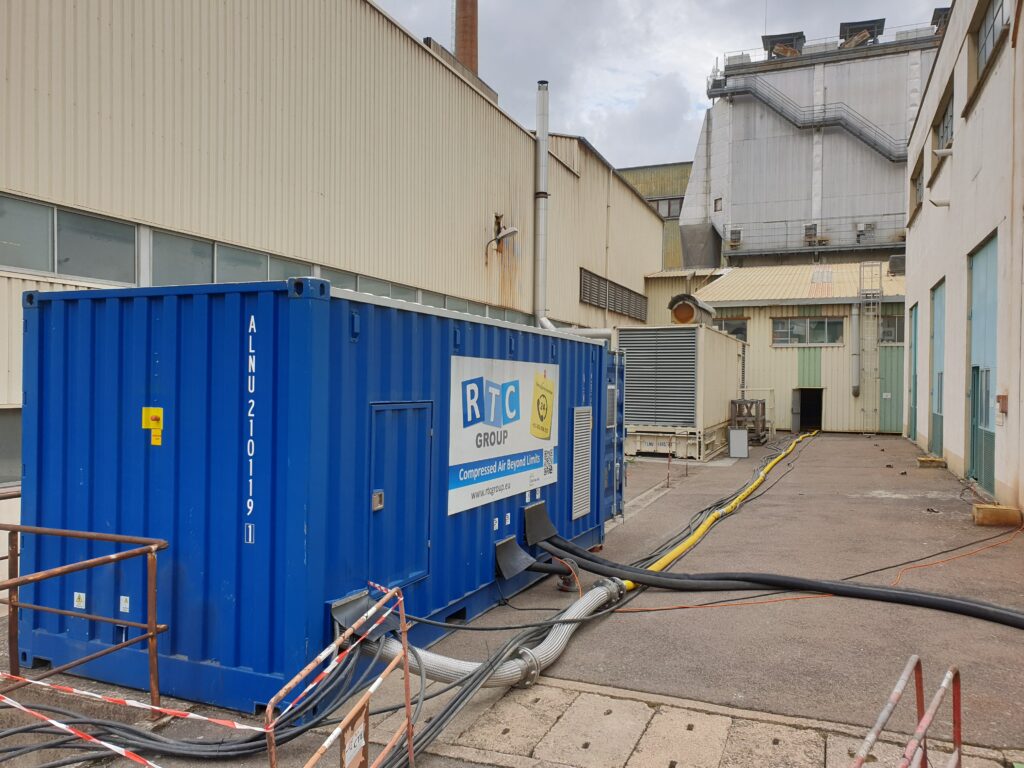
An emergency oil-free compressor can typically be delivered and operational within 24 to 72 hours of a confirmed order, depending on site location, equipment availability, and the complexity of the installation. For sites within mainland Europe with straightforward access and a clear power supply, same-day or next-day mobilisation is achievable. The sections below address the specific factors that shape delivery speed, what installation involves, and when to make the call.
What factors determine how fast a compressor can be mobilised?
Mobilisation speed for an emergency compressed air solution depends on four core variables: equipment availability from the rental fleet, the distance between the depot and the site, the site’s power infrastructure, and how quickly the client can provide technical information. When all four align, compressor delivery time can be measured in hours rather than days.
Fleet availability is the first constraint. A specialist with a large, diverse fleet of oil-free compressors across Europe can respond far faster than a general equipment hire company that stocks one or two units. RTC Group operates the largest centrifugal oil-free air compressor rental fleet in Europe, which directly reduces the time between a call and a truck leaving the depot.
The power supply situation on site is equally critical. If the site has a compatible low-voltage or medium-voltage supply ready at the connection point, the compressor can be connected quickly. If a transformer needs to be sourced and installed first, that adds time. Diesel and hybrid oil-free units sidestep this problem entirely: a diesel compressor can be positioned and running without any electrical infrastructure at all, making it the fastest option when power availability is uncertain.
Finally, the quality of the technical brief from the client matters. Knowing the required flow rate, pressure, air purity specification, and connection point in advance allows the supplier to load the right equipment on the first vehicle. Incomplete information leads to delays, wrong equipment, or a second trip.
Need Reliable Oil-Free Compressed Air?
Our experts help you find the right compressed air rental solution for your industrial needs.
How long does installation of a temporary oil-free compressor take?
Installation of a temporary oil-free compressor typically takes between four and eight hours for a straightforward single-unit deployment, assuming site access is clear and the connection point is prepared. More complex installations involving multiple compressors, air dryers, receivers, and electrical cabling can take one to two days to complete and commission.
The installation scope for a proper temporary compressed air supply goes well beyond placing a compressor on a pad. A complete system includes the compressor itself, an air dryer matched to the process requirement, an air receiver for pressure stability, interconnecting pipework, and the electrical connection. RTC Group handles all logistics, installation, and start-up in-house with the appropriate certifications, which means a single team arrives with everything needed rather than multiple contractors arriving at different times.
Cooling arrangements also affect installation time. Water-cooled centrifugal compressors require a cooling water connection, which must be confirmed and prepared before the unit arrives. Air-cooled screw compressors and diesel units are faster to commission because they have no external cooling dependency. For a past project at a gas separation plant in Belgium, RTC Group supplied a 250 kW electric oil-free screw compressor, a desiccant dryer with a pressure dew point of minus 40 degrees Celsius, and 240 metres of electrical cabling, a scope that illustrates how comprehensive a temporary installation can be.
The practical lesson for operations managers is to have the connection point identified and access cleared before the equipment arrives. Every hour spent waiting for a forklift or locating a water connection is an hour of unnecessary downtime.
What is Class 0 certification and does it affect delivery speed?
ISO 8573-1 Class 0 is a compressed air purity classification, not a supplier certification. It defines the most stringent level of air quality under the ISO 8573-1 standard, specifying that the compressed air contains no detectable oil: neither aerosol, vapour, nor liquid. Equipment described as delivering Class 0 air is designed and verified to meet this standard under defined test conditions.
It is important to distinguish this from company-level certifications such as ISO 9001:2015, which governs quality management systems. A supplier can hold ISO 9001 certification independently of whether the air their equipment produces meets Class 0 purity. The Class 0 designation applies to the air output and the compressor technology: oil-free centrifugal and screw compressors achieve it by design, since there is no oil in the compression chamber that could contaminate the air stream.
In terms of delivery speed, the Class 0 requirement does not inherently slow mobilisation. The oil-free compressors available for emergency rental are already built to deliver oil-free air: the purity is a function of the machine type, not an additional process step. What does require attention is ensuring that any downstream air treatment equipment, such as desiccant dryers or filters, is correctly matched to the process requirement. For industries such as pharmaceuticals, food production, or electronics manufacturing, the full system must be verified before production resumes, which may add commissioning time beyond simply starting the compressor.
What equipment typically comes with an emergency compressor rental?
A complete emergency oil-free compressor rental package typically includes the compressor unit itself, an air dryer suited to the application, an air receiver, interconnecting pipework, and the electrical supply arrangement. For sites without mains power, a diesel or hybrid unit replaces the electrical connection requirement. Supporting accessories such as power transformers, cabling, and monitoring equipment are added based on site conditions.
The dryer specification depends on the process. A refrigerant dryer delivering a pressure dew point of around plus two to three degrees Celsius is sufficient for most general industrial applications. Processes that are moisture-sensitive or where pipework runs through unheated environments require a desiccant dryer, which can achieve pressure dew points of minus 40 degrees Celsius or lower. For a fibres and yarns factory in France, RTC Group supplied a 500 kW water-cooled oil-free centrifugal compressor paired with a refrigerant dryer rated to match the compressor’s full flow, demonstrating how dryer sizing is tied directly to the compressor output.
Medium-voltage compressors introduce a further consideration. Rather than bringing a large temporary transformer to step down the voltage, a medium-voltage oil-free compressor connects directly to the site’s existing medium-voltage supply. This reduces the equipment footprint, cuts installation complexity, and speeds up commissioning, a practical advantage in space-constrained industrial environments.
The full rental equipment range available for temporary compressed air supply covers centrifugal compressors, oil-free screw compressors, desiccant and refrigerant dryers, receivers, and transformers, all sourced and managed by a single supplier to eliminate coordination gaps between contractors.
When should a business call for emergency compressed air support?
A business should call for emergency compressed air support the moment it becomes clear that the existing compressed air supply cannot be restored within the production tolerance window. In practice, this means calling as soon as a compressor failure is confirmed, a reserve unit trips, or a planned maintenance window overruns, not after internal troubleshooting has exhausted several hours.
Many industrial facilities operate on an N+1 redundancy principle: for every compressor required to meet production demand, one additional unit is held in reserve. When that reserve unit fails or is taken offline for unplanned maintenance, the facility loses its safety margin. Production may continue in the short term, but a second failure anywhere in the system would halt output entirely. This is precisely the situation where temporary compressor rental restores the redundancy buffer without requiring a capital purchase.
Beyond emergency failures, there are several planned scenarios where calling early makes a significant difference to the outcome:
- Scheduled plant shutdowns and overhauls, where a temporary supply keeps adjacent production lines running while permanent equipment is serviced
- Capacity gaps during facility expansion, where new permanent equipment has a lead time that outpaces production growth
- Commissioning delays on new installations, where a temporary unit bridges the gap until the permanent system is certified
- Seasonal demand peaks, where short-term additional capacity avoids the cost of permanently oversizing the installed base
The earlier the call is made, the more options are available. 24 hours’ notice allows the right compressor to be prepared, loaded, and routed efficiently. A call made at midnight during a production crisis still triggers a response (RTC Group provides 24/7 support), but site conditions, traffic, and preparation time all compress the margin. For industries where every hour of downtime carries a measurable cost, early escalation is not caution; it is operational discipline.
If your facility is approaching any of these situations, contact RTC Group directly to discuss availability, lead times, and the right configuration for your process requirements.