
Yes, oil-free compressed air rental can directly prevent unplanned production downtime. When a compressor fails or requires maintenance, a temporary oil-free rental unit can be deployed to maintain continuous air supply, keeping production lines running without interruption. For industries where air purity is non-negotiable, such as food, pharmaceutical, and metal processing, rental also eliminates the contamination risk that causes costly unplanned stoppages. The sections below answer the most important questions operations managers and maintenance engineers ask when evaluating oil-free compressor rental as a downtime prevention strategy.
How quickly can a rental oil-free compressor be deployed on-site?
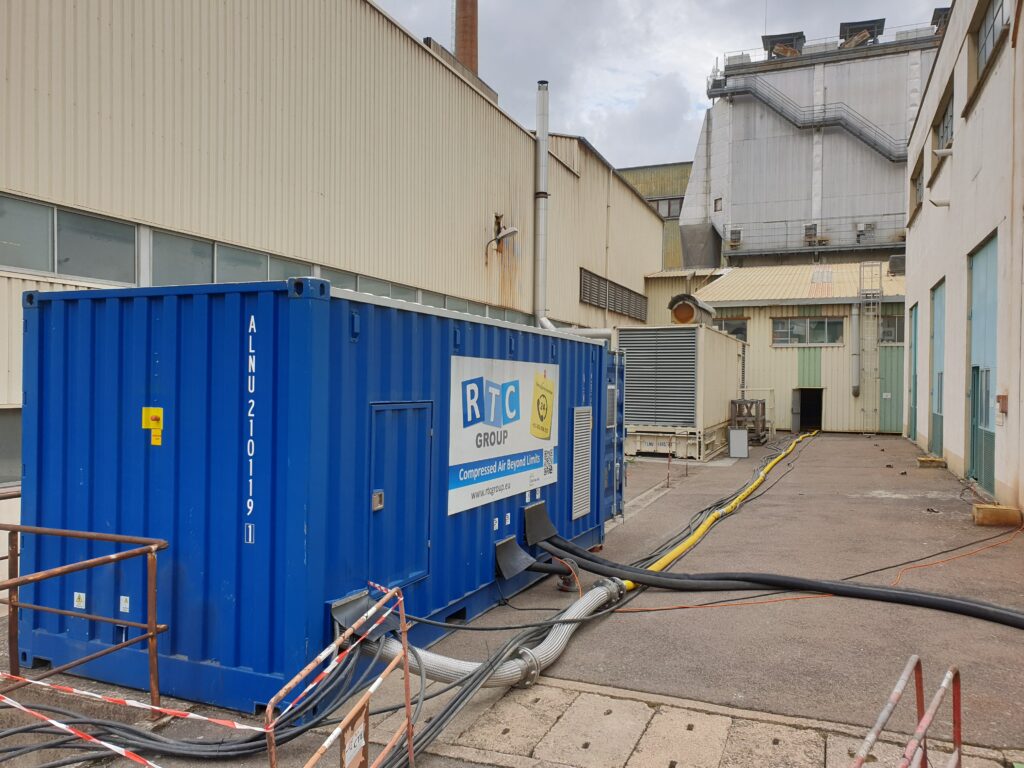
A rental oil-free compressor can typically be deployed within hours to a few days, depending on site conditions, equipment configuration, and delivery distance. RTC Group maintains ready-to-mobilise fleets and handles all delivery, installation, and start-up in-house, meaning a facility facing an emergency compressor failure does not need to coordinate multiple contractors or wait weeks for a permanent replacement.
Speed of deployment depends on several practical factors: the complexity of the required installation, whether a power transformer is needed, and the distance between the rental depot and the site. RTC Group manages its own logistics and has certified engineers on staff, which can compress that timeline considerably. When the rental package includes everything from the compressor and air dryers to air receivers and electrical connections, there is no gap between equipment arrival and first air delivery.
For facilities operating in sectors where every hour of downtime carries significant financial or regulatory consequences, the 24/7 availability of a single point of contact matters as much as fleet size. RTC Group can assess requirements remotely, confirm equipment availability, and dispatch a team immediately, transforming what could be a multi-day crisis into a managed, short-duration interruption.
Need Reliable Oil-Free Compressed Air?
Our experts help you find the right compressed air rental solution for your industrial needs.
What types of production downtime can oil-free air rental prevent?
Oil-free compressed air rental can prevent three main categories of production downtime: unplanned emergency outages caused by compressor failure, planned downtime during scheduled maintenance or overhaul, and capacity shortfalls during facility expansion or peak demand. In each case, a temporary rental supply bridges the gap between current air availability and production requirements.
Emergency compressor failure
When a primary compressor fails without warning, production lines dependent on compressed air stop immediately. A rental unit deployed as an emergency replacement restores air supply quickly, preventing the cascading effects of a full production halt. For industries such as glass manufacturing, chemical processing, or aluminium smelting, where stopping and restarting processes is itself costly and technically complex, this kind of rapid intervention is particularly valuable.
Restoring N+1 redundancy when a standby compressor fails
Many industrial facilities design their compressed air systems around the N+1 principle: alongside the number of compressors required to meet operational demand, one additional standby unit is kept available to cover any single failure. This redundancy is intentional — it ensures that if one compressor goes offline unexpectedly, production continues without interruption while the failed unit is repaired or replaced.
The problem arises when the standby compressor itself fails or requires unplanned maintenance. At that point, the facility is operating without any reserve capacity. If a second compressor then fails, there is nothing to fall back on and production stops. Renting a temporary compressor to restore that N+1 standby position is one of the most operationally sound reasons to engage a rental supplier. The rental unit does not need to carry production load; it simply reinstates the redundancy the system was designed to rely on, until the original standby unit is returned to service.
Planned maintenance and overhaul
Scheduled maintenance windows, compressor overhauls, and plant shutdowns all require a temporary compressed air supply if production is to continue in adjacent areas or restart immediately after work is completed. Rental agreements can be structured for the precise duration of the maintenance window, from a few days to several months, without the capital commitment of purchasing a standby unit that sits idle for most of its life.
Capacity gaps during expansion
Facility expansions, new production line commissioning, and seasonal demand peaks can push existing compressor capacity beyond its limits. A temporary rental supply fills that gap cleanly, without requiring permanent infrastructure changes. Once the expansion is complete or demand normalises, the rental equipment is removed, and the facility returns to its permanent setup.
What is the difference between oil-free and oil-injected compressors in a production environment?
The key difference is where oil is used in the compression process and whether it can reach the compressed air stream. Oil-free compressors use no lubricating oil in the compression chamber, producing air that carries no oil contamination from the compression stage itself. Oil-injected compressors use oil inside the compression element for sealing and cooling, and while downstream filtration can reduce oil content significantly, it cannot guarantee zero oil carryover under all operating conditions.
In a production environment, this distinction has direct consequences. Oil-free compressors are capable of delivering air that meets ISO 8573-1 Class 0 for total oil content, meaning the compression process itself introduces no oil into the air stream. It is important to note that ISO 8573-1 is a standard that defines compressed air purity classes — it describes the quality of the air delivered, not a certification that a supplier holds. Oil-injected machines, even when fitted with high-quality filtration, typically deliver air in the Class 1 range for oil content, which still permits a measurable residual oil concentration. For processes where any oil contamination would compromise product quality, damage downstream equipment, or create safety or regulatory issues, specifying equipment capable of delivering Class 0 air for total oil content is the appropriate technical requirement.
It is worth noting that not every compressor marketed under an oil-free brand name belongs to the oil-free product family. Some rental catalogues include both oil-free and oil-injected equipment. When specifying equipment for a contamination-sensitive process, confirming the compressor type and verifying the air quality it is capable of delivering — rather than assuming based on brand name alone — is essential.
Which industries rely on oil-free compressed air rental to maintain continuity?
Industries that rely on oil-free compressed air rental to maintain production continuity are those where oil contamination in the air supply would directly damage products, compromise safety, or create regulatory issues. The most active sectors include food and beverage, pharmaceutical, metal production, chemical and petrochemical processing, PET bottle blowing, glass, textile, and gas separation.
In food and beverage manufacturing, compressed air contacts packaging, ingredients, and processing equipment directly. Any oil carryover creates a contamination risk that can trigger product recalls and regulatory action. Pharmaceutical and biotech facilities face similar constraints, where sterile or GMP-compliant processes require air supplies that cannot introduce foreign substances. Electronics and semiconductor production, where cleanroom standards govern every input, sits in the same category.
Heavy industry presents a different but equally compelling case. In aluminium smelting, for example, compressed air serves several critical functions: it is used in the pneumatic control systems that regulate electrolysis cell operations, for conveying alumina powder to the reduction cells, and for cooling equipment in and around the potrooms where electrolytic reduction takes place. Interrupting the compressed air supply in a smelter does not simply slow production — it can disrupt the electrochemical process in the pots themselves, with consequences that take hours or days to recover from. In steel production, compressed air is used for oxygen lance control, pneumatic actuators in casting lines, and dust extraction systems, each of which is integral to continuous operation. RTC Group has delivered rental projects at aluminium smelters involving multi-compressor packages delivering over 200 cubic metres per minute, complete with medium-voltage power distribution and desiccant dryers, demonstrating the scale at which temporary compressed air solutions operate in heavy industry.
PET bottle blowing is a specialist case: the process requires high-pressure oil-free air to expand preforms into finished containers, and any oil contamination in a food-grade container is unacceptable. Chemical and petrochemical plants, gas separation facilities, and paper mills round out the core industrial base that treats oil-free air rental as a standard continuity tool rather than a last resort.
Should a facility use a diesel, electric, or hybrid oil-free compressor for emergency backup?
The right choice between diesel, electric, and hybrid oil-free compressors for emergency backup depends primarily on whether a reliable mains power supply is available at the point of deployment. Electric units are the most straightforward where power is accessible. Diesel units are the correct choice where no mains supply exists. Hybrid units are the most flexible option when power availability is uncertain or delayed.
Electric oil-free compressors
Low-voltage electric oil-free compressors connect to standard 400 V supplies and are well suited to facilities with accessible power infrastructure. Medium-voltage variants offer a further advantage: they connect directly to an existing medium-voltage system, removing the need for a large temporary transformer. This is a technically significant benefit in emergency situations where installing transformer infrastructure would add time and complexity. Where power is available and the site electrical infrastructure is compatible, electric units deliver clean, continuous operation with lower running costs than diesel alternatives.
Diesel oil-free compressors
Diesel oil-free compressors are the right choice for sites where mains electricity is unavailable, unreliable, or has itself been disrupted as part of a wider facility failure. They are self-contained and portable, capable of delivering compressed air without any connection to site power. This makes them particularly valuable for outdoor installations, remote sites, or situations where the electrical infrastructure is part of the problem being solved.
Hybrid oil-free compressors
Hybrid units start on diesel power and switch automatically to mains electricity when a supply becomes available. This design addresses one of the most common emergency scenarios: a site where power is coming online but not yet available at the moment the compressor is needed. Rather than waiting for electrical connection or committing to a purely diesel solution, the hybrid unit provides immediate air supply on diesel and transitions to mains power seamlessly, reducing fuel costs and emissions as the situation stabilises. For critical backup and emergency response applications, this flexibility makes hybrid equipment a strong default choice when the power situation is uncertain.
What should a compressed air rental agreement include to protect production uptime?
A compressed air rental agreement that genuinely protects production uptime should cover equipment specification, full installation scope, response time commitments, the duration and flexibility of the rental term, and a single point of accountability. Agreements that leave any of these elements vague create gaps that become visible only when something goes wrong.
Equipment specification must be precise. The agreement should confirm the compressor type (oil-free, not oil-injected), the air quality the equipment is capable of delivering in accordance with ISO 8573-1, flow rate and pressure, and any ancillary equipment included such as air dryers, receivers, and power transformers. A rental package that delivers a compressor but leaves the client to source drying or power distribution independently is not a complete solution.
Installation and commissioning scope should be explicitly stated. The most effective rental arrangements include logistics, on-site installation, electrical connection, and start-up by qualified engineers, all under the rental provider’s responsibility. This removes ambiguity about who is accountable if the system does not perform as required from day one.
Rental term flexibility matters because production situations evolve. An emergency rental that was expected to last two weeks may need to extend to three months if a replacement compressor is delayed, or if a failed standby unit takes longer to repair than anticipated. Agreements that accommodate short-term emergency rentals as well as longer multi-month arrangements, without punitive renegotiation, give operations teams the room to manage real-world timelines. Support availability, including 24/7 contact with a technical specialist, should be confirmed rather than assumed.
Finally, the agreement should reflect a single point of contact who owns the entire scope. When one party is responsible for equipment, engineering, logistics, and after-hours support, there is no ambiguity about who to call when a problem arises. Facilities evaluating rental options can explore the full scope of what RTC Group’s managed rental equipment package covers before committing, and discuss specific requirements directly with a specialist to ensure the agreement reflects actual production needs rather than a generic template.