

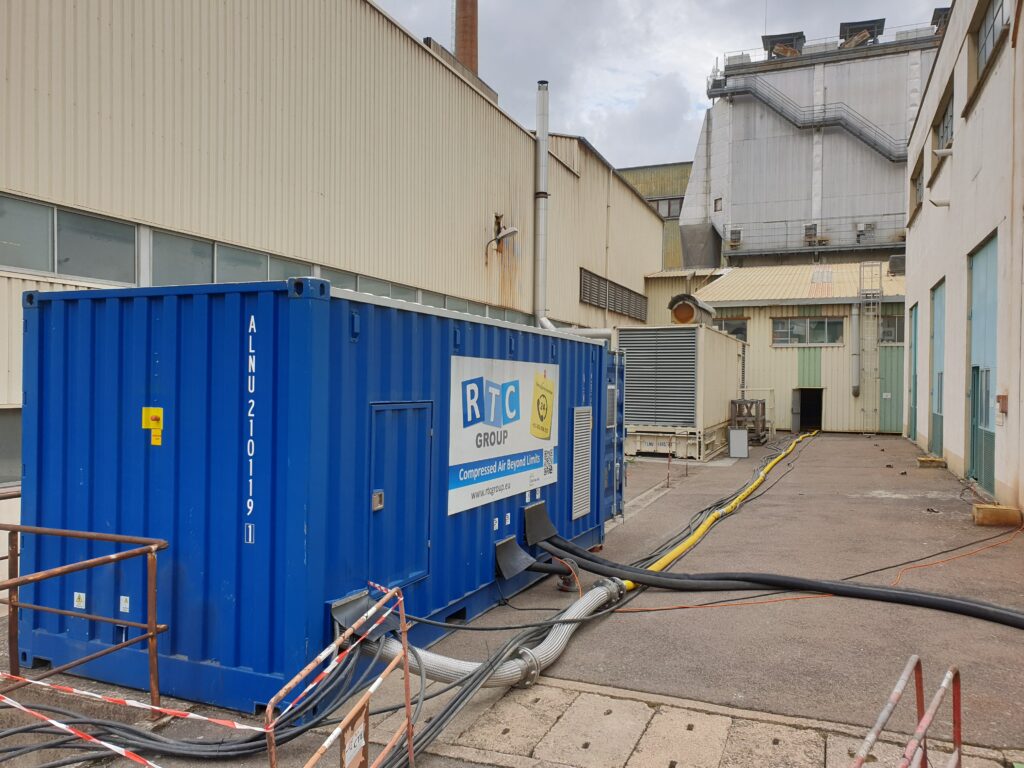
Oil contamination in compressed air systems poses serious risks to health, equipment, and product quality. Oil enters the air stream through compressor lubrication, and even trace quantities can cause product spoilage, regulatory violations, machinery failure, and, in some environments, direct harm to workers or consumers. The following sections break down exactly how contamination occurs, what damage it causes, which industries are most exposed, and how to prevent it.
How does oil get into a compressed air system?
Oil enters a compressed air system primarily through the compressor itself. In oil-lubricated compressors, lubricant is used to seal, cool, and reduce friction between moving components. During compression, microscopic oil droplets and aerosols are carried into the air stream as carryover. Even with downstream filtration, some residual oil vapour can pass through, particularly as filter elements age or become saturated.
Beyond the compressor, several other sources contribute to oil contamination in compressed air:
- Degraded or incorrectly specified filters that no longer capture oil aerosols at the rated efficiency
- Compressor wear, which increases oil carryover as internal seals and components deteriorate over time
- Ambient air quality, since compressors draw in whatever is present in the surrounding environment, including oil mist from nearby machinery
- Condensate contamination, where water that condenses in the system mixes with oil residues already present in pipework
- Poorly maintained distribution systems, where oil deposits from earlier contamination events continue to shed into the air stream
This is why the distinction between oil-free and technically oil-free compressed air matters in practice. A technically oil-free system uses an oil-lubricated compressor with downstream filtration to reduce contamination to low levels, typically delivering air that meets ISO 8573-1 Class 1 for oil content. A genuinely oil-free compression process eliminates oil from the compression stage entirely, removing the primary source rather than treating the output after the fact.
Need Reliable Oil-Free Compressed Air?
Our experts help you find the right compressed air rental solution for your industrial needs.
What are the health and safety risks of oil-contaminated compressed air?
Oil-contaminated compressed air presents direct health hazards when it comes into contact with workers or end products. Inhaling oil aerosols or vapours can irritate the respiratory tract and, with prolonged exposure, cause more serious lung conditions. In food, beverage, and pharmaceutical production, oil carryover into products intended for human consumption or medical use creates a contamination risk with potential consequences for public health.
The risks extend beyond inhalation. Oil mist in a compressed air system used for pneumatic tools or breathing air applications can expose operators to sustained low-level contamination that accumulates over time. In environments where compressed air is used for direct product contact — blowing, conveying, or packaging — any oil present reaches the end consumer.
From a regulatory standpoint, oil contamination can trigger non-compliance with food safety standards, pharmaceutical Good Manufacturing Practice requirements, and occupational health regulations. Facilities found to be operating with contaminated air supplies face product recalls, production shutdowns, and significant legal liability. The health risk is not always visible or immediately detectable, which makes it particularly difficult to manage without the right equipment and monitoring in place.
How does oil contamination damage production equipment and processes?
Oil contamination in compressed air causes progressive and often costly damage to downstream equipment and production processes. Oil coats internal surfaces of pneumatic valves, cylinders, and actuators, causing them to stick, malfunction, or fail prematurely. In precision instruments and control systems, even thin oil films can disrupt calibration and sensor accuracy.
In processes that rely on compressed air for direct product contact or surface treatment, oil contamination degrades quality in ways that are difficult to reverse. Paint and coating applications suffer adhesion failures when oil is present in the air supply. Blowing processes for packaging and containers risk contaminating the product interior. Drying and curing operations can be compromised when oil-laden air interferes with the process chemistry.
Oil also interacts with moisture in compressed air systems to form emulsions and sludge that accumulate in pipework, receivers, and dryers. This buildup restricts airflow, contributes to pressure drop across the distribution system, and accelerates corrosion of metal components. Over time, the combined effect of fouled components, increased maintenance frequency, and unplanned downtime represents a significant operational cost — one that typically far exceeds the initial cost difference between oil-lubricated and oil-free compression.
What industries face the greatest risk from oil in compressed air?
Industries where compressed air comes into direct contact with products, people, or sensitive processes face the greatest risk from oil contamination. Food and beverage manufacturing, pharmaceutical production, and electronics assembly are the most acutely exposed, because even trace oil contamination can render products unsafe, non-compliant, or defective. In these sectors, the consequences of contamination are not limited to equipment damage; they extend to product recalls, regulatory action, and reputational harm.
Other high-risk sectors include:
- PET bottle blowing, where high-pressure air is forced into heated PET preforms to shape the bottle; any oil present enters the container interior directly, making oil-free air a process requirement rather than a preference
- Chemical and petrochemical processing, where oil contamination can interfere with reactions, catalyst performance, or product purity
- Textile and fibre production, where air is used for yarn transport and texturising, and oil staining causes irreversible quality defects
- Glass manufacturing, where compressed air is used in forming and cooling processes sensitive to surface contamination
- Steel production, where large volumes of compressed air are used for instrumentation, lance injection, and process control across continuous casting and rolling operations
- Aluminium smelting, where compressed air is used for cooling electrolysis cells — known as pots — as well as for pneumatic conveying of alumina and process instrumentation; contamination in pot cooling circuits can affect cell temperature stability and reduce operational efficiency
Across all of these sectors, a compressor failure or contamination event mid-production is not merely an inconvenience: it stops the line. The industries that depend most heavily on a continuous, uncontaminated air supply are precisely those that can least afford the downtime that contamination events bring with them. You can explore how RTC Group supports these industries with certified temporary compressed air solutions.
What is ISO 8573 and how does it classify compressed air purity?
ISO 8573 is the international standard that defines compressed air quality classes, covering three main contaminant categories: solid particles, water, and oil. It provides a framework for specifying and verifying the purity of compressed air at the point of use, giving both suppliers and end users a consistent reference for what “clean” compressed air actually means in measurable terms.
The standard assigns a numerical class to each contaminant type, with lower numbers indicating higher purity. For oil content — the most relevant classification for contamination risk — the classes range from Class 1 through to Class 4. Class 0 sits outside the standard’s defined numerical range and represents a more stringent specification than Class 1. It is not a certification held by a supplier; rather, it is a technical designation applied to compressed air quality. When a compressor manufacturer describes their equipment as delivering Class 0 air, they are stating that the compression process introduces no measurable oil into the air stream. The specific limit must be agreed between the equipment supplier and the end user, as ISO 8573-1 does not define a fixed numerical threshold for Class 0.
Understanding the distinction between ISO classes matters when specifying equipment. Air that meets Class 1 for oil content is typically produced by oil-lubricated compressors equipped with high-efficiency downstream filtration — what is sometimes called technically oil-free air. Air that meets Class 0 requirements, as defined by agreement between supplier and user, is generally produced by genuinely oil-free compression technology that eliminates oil at the source. When selecting compressed air equipment for sensitive applications, always confirm which ISO 8573-1 class the system is rated to deliver at the point of use, not just at the compressor outlet, and verify this through appropriate air quality testing.
How can oil contamination in compressed air be prevented or eliminated?
The most reliable way to prevent oil contamination in compressed air is to eliminate oil from the compression process entirely by using oil-free compressor technology. Unlike oil-lubricated machines that rely on downstream filtration to reduce carryover, oil-free compressors use alternative bearing and sealing arrangements that require no lubricant in the compression chamber, removing the primary contamination source at the design level.
For facilities where oil-free compression is already in place, or where additional safeguards are needed alongside existing equipment, a layered approach to contamination control is effective:
- Select the right compressor technology: specify oil-free compression for any application involving direct product contact, food safety requirements, or pharmaceutical compliance
- Install appropriate air treatment: refrigerant dryers remove bulk moisture, while desiccant dryers achieve the lower dew points required for moisture-sensitive processes; both reduce the conditions that allow oil and water to interact and form sludge
- Maintain filtration systems rigorously: replace filter elements on schedule and monitor differential pressure to confirm they are performing as rated
- Audit the distribution system: inspect pipework, receivers, and condensate drains for oil deposits, and address any identified sources before they contaminate downstream equipment
- Monitor air quality at the point of use: periodic testing against the relevant ISO 8573-1 class confirms that the system is delivering air at the specified purity, not just at commissioning but throughout its operational life
Many industrial facilities operate their compressed air supply on an N+1 basis — meaning that alongside the compressors required to meet operational demand, one additional standby unit is kept available to maintain continuity if a primary compressor trips or requires unplanned maintenance. When that standby compressor itself fails or is taken out of service for scheduled work, the facility loses its redundancy buffer. In this situation, hiring a temporary oil-free compressor restores the N+1 configuration without requiring production to be curtailed or air quality standards to be compromised.
Beyond redundancy, there are several other practical reasons why industrial operators hire temporary compressed air equipment: planned overhauls of permanent compressors, seasonal or project-based capacity increases, commissioning support during new plant start-up, and emergency response to unexpected failures. In each case, the requirement is the same — a fast, reliable supply of air that meets the quality specification the process demands.
RTC Group’s oil-free compressor rental fleet covers everything from the compressor and air treatment through to installation and start-up, giving operations teams a complete, managed solution without the risks that come with unplanned compromises on air quality. If you are assessing your options, the full equipment range covers the breadth of available configurations.