
Pharmaceutical plants require 100% oil-free compressed air because even trace amounts of oil contamination can compromise product sterility, trigger batch failures, damage sensitive equipment, and put patient safety at risk. Regulatory frameworks including GMP guidelines mandate that compressed air in direct or indirect product contact must be free from harmful contaminants, and oil is among the most consequential of those. The sections below address the most common questions pharmaceutical engineers and procurement managers ask when specifying or sourcing compressed air for their facilities.
What happens if oil-contaminated air enters a pharmaceutical process?
If oil-contaminated compressed air enters a pharmaceutical process, it can adulterate active ingredients, compromise sterile environments, destroy batch integrity, and expose manufacturers to regulatory sanctions. Even microscopic oil aerosols or vapour carry the potential to degrade product quality in ways that are not always immediately visible, making contamination events particularly dangerous in pharmaceutical settings.
In direct-contact applications, such as pneumatic conveying of powders, tablet coating, or filling line purging, oil particles can physically mix with the product. The result is a contaminated batch that must be quarantined and destroyed, with all the associated financial and reputational consequences. In indirect-contact applications, oil residue can accumulate on equipment surfaces, valves, and pipework, creating conditions where microbial growth is more likely and where subsequent cleaning validation becomes significantly more complex.
Beyond the product itself, oil contamination affects the compressed air system. Oil coats the internal surfaces of distribution pipework and clogs downstream filtration, reducing flow efficiency and creating pressure drop across the network. Instruments and control valves exposed to oil mist can malfunction or fail prematurely, introducing process variability at exactly the points where consistency is most critical.
Regulatory consequences are equally serious. A contamination event identified during an inspection by a national medicines authority or during an internal audit can result in production shutdowns, product recalls, and formal non-conformance reports that affect a manufacturer’s licence to operate. For pharmaceutical companies, the cost of a single contamination incident typically far exceeds the investment required to specify and maintain a fully oil-free compressed air system from the outset.
Need Reliable Oil-Free Compressed Air?
Our experts help you find the right compressed air rental solution for your industrial needs.
What compressed air purity standards apply to pharmaceutical manufacturing?
The primary international standard governing compressed air purity in pharmaceutical manufacturing is ISO 8573-1, which classifies air quality across three key contaminant groups: solid particles, water, and oil. Pharmaceutical manufacturers typically specify that compressed air must meet Class 1 or Class 0 oil purity levels as defined by ISO 8573-1. Class 0 represents the most stringent classification, requiring oil concentrations below the detection threshold of the measurement method. It is important to note that ISO 8573-1 Class 0 is a purity classification that describes the quality of the compressed air itself — it is not a certification that a supplier or compressor manufacturer automatically holds by virtue of supplying equipment.
ISO 8573-1 does not operate in isolation. Good Manufacturing Practice regulations, commonly referred to as GMP, set the overarching compliance framework for pharmaceutical production in Europe and globally. GMP guidelines require that compressed air used in manufacturing processes must be of defined and validated quality, and that this quality is documented, monitored, and maintained. The European Medicines Agency’s GMP Annex 1, which governs sterile medicinal product manufacturing, places particularly strict demands on air quality in cleanroom and aseptic environments.
Pharmacopoeial standards, including the European Pharmacopoeia and the United States Pharmacopeia, also include monographs for medicinal air and compressed air used in direct product contact. These define acceptable limits for a range of contaminants and require that compressed air systems are subject to ongoing qualification and periodic testing.
In practice, pharmaceutical quality teams work with ISO 8573-1 as the technical classification tool and GMP requirements as the regulatory driver. Together, they define what purity class the air must achieve, what treatment train is required to achieve it, and what evidence must be generated and retained to demonstrate ongoing compliance. Specifying oil-free compressed air is not simply a best practice in this context; it is a regulatory obligation that must be supported by documented evidence.
How does oil-free compressed air differ from filtered compressed air?
Oil-free compressed air is produced by a compressor whose compression mechanism contains no lubricating oil, meaning no oil enters the air stream at the point of compression. Filtered compressed air, sometimes called technically oil-free air, is produced by an oil-lubricated compressor whose output is then treated by downstream coalescing filters and activated carbon to reduce oil content to a defined level. The fundamental difference is whether oil is absent by design or removed after the fact.
This distinction matters significantly in pharmaceutical applications. An oil-free compressor eliminates the source of contamination entirely. A filtered oil-lubricated compressor reduces contamination to a level that may meet a lower purity class, but the downstream filtration system introduces its own maintenance requirements and potential failure modes. If a filter element becomes saturated, bypassed, or incorrectly maintained, oil breakthrough can occur downstream without immediate detection.
From a purity classification perspective, oil-free compressors are the equipment of choice for producing compressed air that meets ISO 8573-1 Class 0 oil purity — the most stringent level defined by the standard. Filtered oil-lubricated equipment is generally associated with Class 1, which permits a very small but measurable oil concentration. For pharmaceutical manufacturers operating under GMP, the validation burden associated with a filtered oil-lubricated system is typically higher, because the effectiveness of the filtration train must itself be validated and monitored continuously.
Oil-free compressors also simplify the overall air treatment system. Without oil in the compression stage, the treatment train can focus on moisture removal and particulate filtration rather than oil removal, reducing the number of components that require maintenance and the number of potential contamination pathways. For pharmaceutical plants where system simplicity supports validation and audit readiness, this is a meaningful operational advantage.
Which pharmaceutical processes rely most heavily on oil-free compressed air?
The pharmaceutical processes most dependent on oil-free compressed air are those involving direct product contact, sterile manufacturing, and cleanroom environments. These include pneumatic conveying of active pharmaceutical ingredients and excipients, tablet compression and coating, vial filling and capping, lyophilisation, and the purging of sterile packaging lines. Any process where compressed air touches or is in close proximity to the product requires the highest level of air purity.
In sterile and aseptic manufacturing, compressed air is used to operate isolators, laminar flow hoods, and controlled environment systems. Contamination in these areas can compromise the entire sterile boundary, making oil-free air a non-negotiable requirement. GMP Annex 1 facilities, which produce injectable medicines and other sterile products, are among the most demanding environments for compressed air quality in any industry.
Fermentation and biotechnology processes also rely on oil-free air. In bioreactors, compressed air or oxygen-enriched air is sparged directly into the culture medium to support cell growth. Oil contamination at this point would be toxic to the biological cultures and would invalidate the batch. The same principle applies to compressed air used in chromatography systems and other downstream purification equipment, where even trace oil contamination can interfere with separation performance and column integrity.
Beyond direct product contact, instrument air used to operate pneumatic control valves, actuators, and analytical instruments throughout a pharmaceutical plant must also be reliably clean and dry. While the purity requirements for instrument air may be somewhat less stringent than for product-contact air, the consequences of instrument failure in a GMP environment can be significant, particularly where automated process control is linked to batch records and regulatory submissions.
When should a pharmaceutical plant use a rental oil-free compressor?
A pharmaceutical plant should consider a rental oil-free compressor when its installed compressed air capacity is temporarily unavailable, insufficient, or undergoing maintenance, and when production cannot be interrupted. Planned shutdowns, emergency compressor failures, capacity expansions, and facility validation periods are all situations where a temporary, oil-free compressed air supply becomes essential to maintaining GMP compliance and keeping production running.
Planned maintenance and overhaul are among the most common triggers. When a pharmaceutical manufacturer schedules a major compressor service or system upgrade, production typically cannot simply pause for the duration of the work. A temporary rental compressor bridges the gap, maintaining the required air purity and flow capacity throughout the maintenance window without compromising GMP compliance or batch continuity.
Redundancy is another important operational consideration. Many pharmaceutical facilities operate on an N+1 basis, meaning that alongside the compressors required to meet normal production demand, one additional standby unit is kept available to cover any single point of failure. If that standby compressor is taken out of service for repair or scheduled maintenance, the facility’s redundancy is temporarily lost. Hiring a rental oil-free compressor during this period restores the N+1 configuration, ensuring that production remains protected against a further unexpected failure while the permanent standby unit is unavailable.
Emergency failures present an even more time-critical scenario. A compressor breakdown mid-production in a sterile filling suite or a tablet manufacturing area can halt an entire facility within hours. In these situations, the speed of mobilisation matters as much as the technical specification of the equipment. A rental supplier that can deliver, install, and commission an oil-free compressor rapidly, and handle all logistics and connections in-house, is the difference between a recoverable incident and a prolonged production loss.
Facility expansions and new product launches also create temporary capacity gaps. When a pharmaceutical company brings a new production line online or increases batch sizes ahead of a product launch, existing compressed air infrastructure may not be sized for the increased demand. A rental solution provides the additional capacity needed during the ramp-up period without requiring immediate capital investment in permanent equipment.
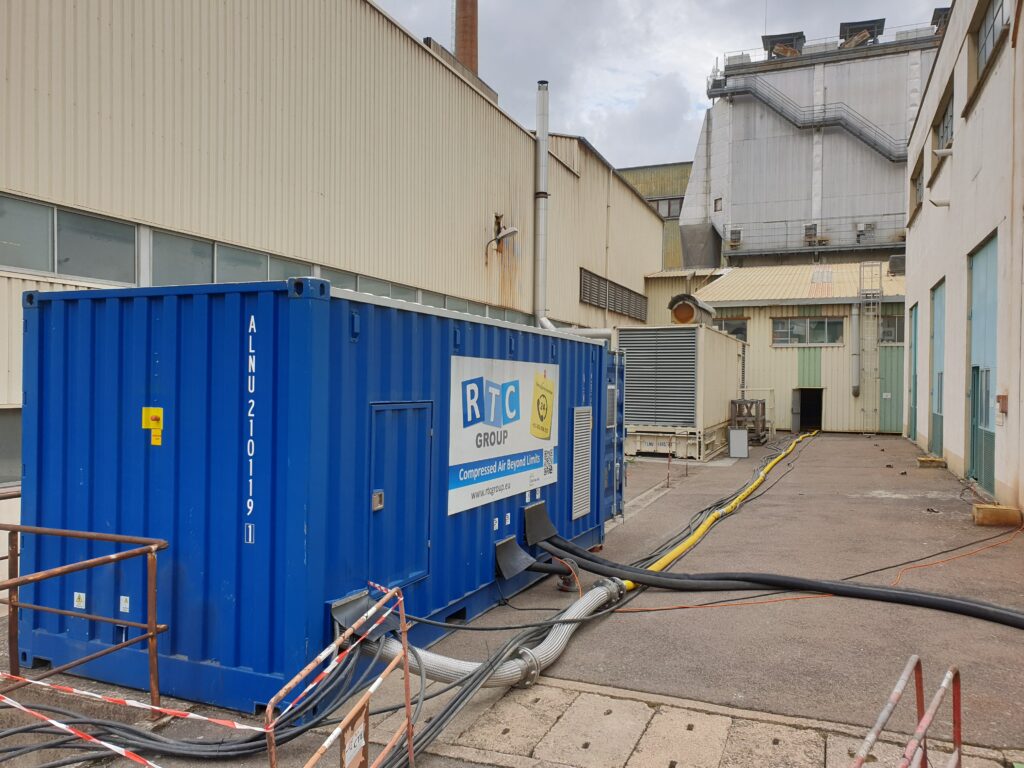
For pharmaceutical plants evaluating temporary compressed air options, the critical requirement is that the rental equipment is capable of delivering air that meets the same purity standards as the permanent installation. Oil-free compressor rental from a specialist supplier includes not only the compressor itself but also the full treatment train, air dryers, receivers, and all necessary connections, ensuring that the temporary supply is fully compliant from day one. RTC Group manages the complete installation process, from delivery and engineering through to start-up, with a single point of contact available around the clock, which is particularly valuable in time-sensitive pharmaceutical environments where every hour of downtime carries a measurable cost. For facilities that want to discuss specific requirements or response times, the RTC Group team is available to assess the situation and propose a solution.