A turnkey compressed air solution is a fully managed service in which a single provider designs, supplies, delivers, installs, and commissions an entire compressed air system for an industrial facility. The client receives a complete, operational system rather than individual pieces of equipment to coordinate independently. For industrial facilities where downtime is not an option, this end-to-end approach eliminates gaps between equipment, logistics, and technical expertise.
The sections below unpack what that solution actually includes, when facilities need one, how it differs from standard rental, where Class 0 oil-free air fits in, and what to ask before signing a contract.
What does a turnkey compressed air solution actually include?
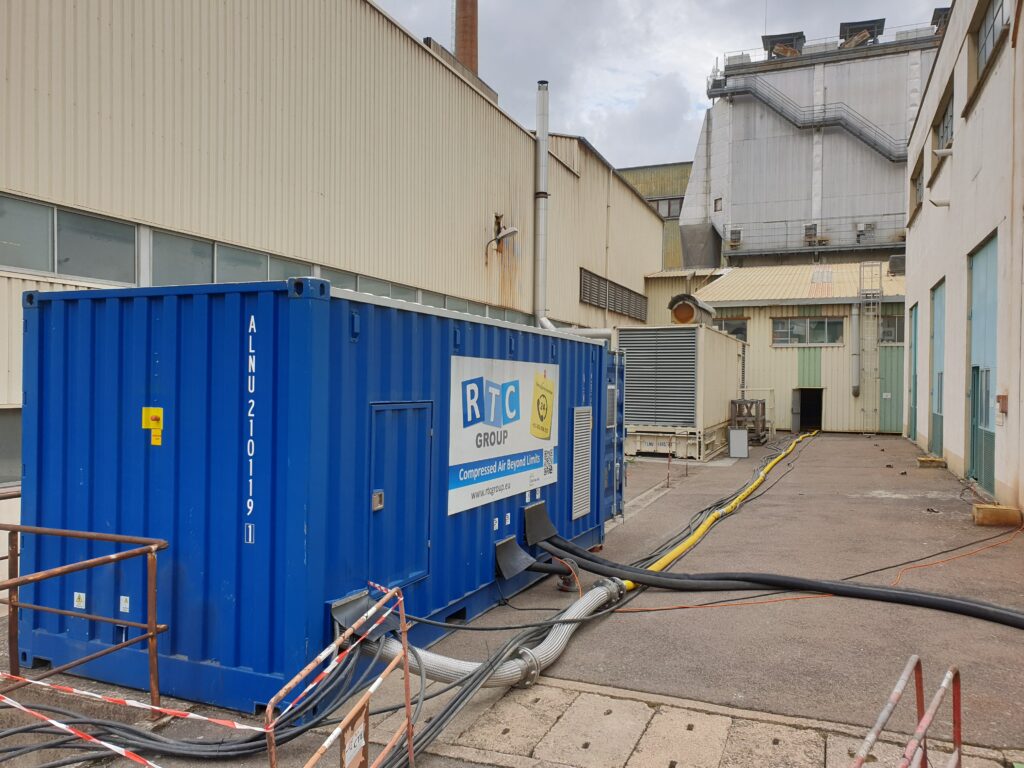
A turnkey compressed air solution includes every component and service required to deliver pressurized air to a production process, from the compressor itself through to the point of use. This covers equipment selection, engineering design, logistics, on-site installation, electrical connections, and system commissioning. The provider manages all of it, so the facility team receives a working system rather than a collection of machines to integrate themselves.
In practice, the equipment scope goes well beyond the compressor unit. A complete temporary compressed air supply typically includes:
- Compressors: oil-free screw or centrifugal units sized to the required flow and pressure
- Air dryers: refrigerant dryers for standard moisture control or desiccant dryers for applications demanding pressure dew points as low as -40°C
- Air receivers and buffer vessels: to stabilize system pressure and manage demand peaks
- Power transformers: where site voltage does not match compressor requirements
- Distribution pipework and hoses: including all interconnecting cables and protection
- Ancillary cooling systems: cooling-water chillers where water-cooled compressors are used
The engineering work behind the scenes is equally important. A genuine turnkey provider conducts a site assessment, calculates the required flow and pressure, selects equipment that matches those parameters, and manages all logistics from transport to start-up. Real-world projects illustrate the complexity involved: a steel factory project in Finland required a 300 kW oil-free screw compressor, a 10,000-litre receiver, a refrigerant dryer, a high-pressure booster, a voltage transformer, and hundreds of metres of cabling and hose. An aluminium smelter project in Iceland involved medium-voltage distribution, two large compressors delivering a combined 206 m³/min, three desiccant dryers, and dual cooling-water chillers — partly to supply the cooling air used for electrolysis cell pot cooling. None of those installations could have been assembled by sourcing individual components from separate suppliers.
The service layer matters just as much as the hardware. A single point of contact throughout the project, 24/7 support availability, and full responsibility for commissioning are what separate a true turnkey arrangement from a simple equipment hire.
Need Reliable Oil-Free Compressed Air?
Our experts help you find the right compressed air rental solution for your industrial needs.
When does an industrial facility need a turnkey compressed air solution?
An industrial facility needs a turnkey compressed air solution whenever its primary compressed air supply fails, is taken offline, or cannot meet production demand on its own. The most common triggers are unplanned compressor failure, the loss of a standby unit, scheduled maintenance or plant shutdown, and capacity expansion during facility upgrades. In each case, the facility needs a complete working system delivered quickly, not individual components to self-assemble.
Emergency and unplanned failures
A compressor breakdown mid-production is the most time-critical scenario. For industries such as steel, food processing, pharmaceutical manufacturing, or gas separation, even a short interruption to the compressed air supply can halt entire production lines. The response requirement is measured in hours, not days, which is why emergency compressor rental must come as a complete, ready-to-run package rather than a series of separate deliveries.
Standby unit failure and the N+1 principle
Many industrial facilities operate on an N+1 redundancy principle: alongside the number of compressors required to meet operational demand, one additional standby unit is kept available so that if any running compressor fails, production can continue without interruption. When that standby unit itself breaks down or is taken out of service for repair, the facility loses its safety margin entirely. A temporary turnkey compressed air solution can restore that redundancy while the permanent standby unit is being repaired or replaced, ensuring the facility is never left exposed. This is a common and practical reason for hiring temporary compressed air capacity that is often overlooked when only emergency breakdowns are discussed.
Planned shutdowns and scheduled maintenance
Many facilities plan periodic overhauls of their permanent compressed air infrastructure. During these windows, production may still need to continue, or the shutdown may be extended beyond its original schedule. A turnkey temporary compressed air supply bridges that gap, providing a fully engineered alternative system that runs in parallel or replaces the offline equipment for the duration. Projects of eight to twenty-two weeks are common across sectors including chemical processing, sugar production, and textile manufacturing.
Capacity gaps during expansion
When a facility is expanding, upgrading equipment, or commissioning new production lines, existing compressed air infrastructure may be insufficient for the transition period. A temporary turnkey solution fills that capacity gap without requiring permanent capital investment before the new infrastructure is ready.
What’s the difference between a turnkey solution and standard compressor rental?
The key difference between a turnkey compressed air solution and standard compressor rental is scope and responsibility. Standard rental provides a compressor unit; the client is responsible for connecting it, integrating it with existing systems, sourcing any additional equipment, and ensuring it operates correctly. A turnkey solution transfers all of that responsibility to the provider, who delivers a complete, commissioned system ready to supply air to the process.
Standard rental suits facilities that have the internal engineering resources to integrate a compressor into their existing infrastructure and only need additional capacity or a backup unit. It works when the site already has compatible electrical supply, appropriate air treatment, and the technical staff to manage commissioning.
A turnkey arrangement is the appropriate choice when:
- The required system involves multiple components that must work together as an engineered whole
- The facility lacks the internal resources to manage installation and commissioning
- Speed is critical and there is no time to coordinate multiple suppliers
- The application requires oil-free air meeting the purity levels defined by ISO 8573-1 Class 0, which demands careful selection and verification of every component in the air treatment train
- The site has unusual power requirements, such as medium-voltage supply or no mains electricity at all
The commercial difference is also significant. With standard rental, any gap between equipment capability and production requirement is the client’s problem. With a turnkey solution, the provider is accountable for the system performing as specified. That accountability is what industrial facilities with no tolerance for downtime are paying for.
Providers like RTC Group handle the entire temporary compressed air supply from start to finish, including all equipment, engineering, logistics, and installation, which is the defining characteristic of a genuine turnkey offering rather than a basic hire arrangement.
How does Class 0 oil-free air fit into a turnkey compressed air setup?
Class 0 is the highest purity classification for compressed air under ISO 8573-1, meaning the air contains no detectable oil in any form: no aerosols, no vapour, no particles. This classification describes the quality of the air itself, not a certification held by a provider. In a turnkey compressed air setup, delivering air that meets Class 0 purity requires that every component in the system — from the compressor through to the air treatment equipment — is specified and installed to maintain that purity standard throughout.
This matters because oil contamination in compressed air does not only come from the compressor itself. Poorly selected dryers, contaminated receivers, or inadequate filtration can introduce or allow contamination even when an oil-free compressor is in use. A genuine turnkey provider selects the entire air treatment train to protect purity, not just the compressor in isolation.
Oil-free air meeting Class 0 purity levels is required in several industries, each for specific process reasons:
- Food and beverage: compressed air contacts products or packaging directly during processes such as conveying, filling, and sealing, where any oil contamination would compromise product safety
- Pharmaceutical: sterile compressed air is used in tablet coating, filling, and packaging operations where regulatory frameworks such as GMP set strict contamination limits
- Electronics and semiconductor manufacturing: compressed air is used for component handling and cleaning in environments where even trace hydrocarbon contamination can damage sensitive components or cause yield loss
- PET bottle blowing: high-pressure oil-free air at roughly 35 to 42 bar is forced directly into the bottle mould, making any oil contamination a direct food-contact risk
- Gas separation: compressed air is the feed gas for processes such as pressure swing adsorption, where oil contamination degrades the adsorbent beds and affects the purity of the separated gas streams
In a turnkey context, the ability to deliver air at Class 0 purity is verified at system level, not just at the compressor nameplate. The provider must confirm that the selected dryers, receivers, and distribution equipment maintain the purity specification under actual operating conditions. For facilities in regulated industries, this documented assurance is as important as the air quality itself. An oil-free compressor rental that forms part of a fully engineered system provided by RTC Group delivers that assurance in a way that a standalone hire unit cannot.
What should you ask a turnkey compressed air provider before signing a contract?
Before signing a contract with a turnkey compressed air provider, you should ask questions that verify their technical capability, scope of responsibility, response commitments, and the quality standards their equipment and systems meet. The goal is to confirm that the provider can genuinely deliver a complete, compliant system rather than a compressor with loose promises around the rest.
The most important questions to ask are:
- What exactly is included in the scope? Ask for a written list of every component, including dryers, receivers, transformers, hoses, cables, and any ancillary equipment. Gaps in scope become your problem after the contract is signed.
- Who is responsible for installation and commissioning? A genuine turnkey provider handles both with its own certified personnel, not subcontractors you have no visibility over.
- What quality standards does the system meet? For oil-free applications, confirm that the delivered air meets ISO 8573-1 Class 0 purity levels and ask how the provider verifies this across the full system, not just at the compressor outlet. For electrical installation work, ask about the relevant low-voltage and medium-voltage installation qualifications that apply in your jurisdiction. Ask also whether the provider operates under a quality management framework such as ISO 9001.
- What is the response time for emergency deployment? Understand whether the provider can mobilise within hours or whether lead times extend to days. Ask what stock is held in their rental fleet rather than what can be sourced on request.
- Who is the single point of contact throughout the project? Confirm that one named contact manages the entire engagement, including logistics, installation, and any issues during operation.
- What support is available during the rental period? Ask specifically about out-of-hours availability and what happens if a component fails mid-rental.
- Can they handle your specific power supply? If your site runs on medium voltage, ask whether the provider can connect directly to your existing supply or whether a temporary transformer is required, and who supplies it.
The answers to these questions will quickly distinguish a provider with genuine turnkey capability from one that assembles a system from whatever is available and calls it turnkey. For facilities where compressed air failure means production failure, that distinction is the most important factor in the procurement decision. If you are ready to discuss a specific requirement, the most direct route is to contact a specialist at RTC Group who can assess your site conditions and confirm what a compliant, complete solution looks like for your application.