Renting an oil-free compressor is almost always the smarter financial choice when your compressed air need is temporary, urgent, or tied to a specific project. You avoid large capital expenditure, skip the burden of ownership costs, and gain access to fully maintained equipment that can be on site and running far faster than a purchase could be arranged. For industrial operations where Class 0 air purity is non-negotiable, rental also removes the technical risk of selecting, commissioning, and maintaining highly specialised equipment in-house. The sections below answer the most common questions buyers and operations managers ask before making the rent-or-buy decision.
When does renting an oil-free compressor make more financial sense than buying?
Renting an oil-free compressor makes more financial sense than buying whenever the requirement is temporary, unplanned, or capacity-driven rather than permanent. Purchasing a large industrial compressor ties up significant capital, adds depreciation to the balance sheet, and commits your maintenance team to a long-term asset. Renting converts that fixed cost into a predictable operating expense with no residual value risk.
The financial case for rental becomes even stronger when you factor in the full cost of ownership. A large oil-free centrifugal compressor is not a standard piece of plant equipment. It requires specialist commissioning, periodic overhaul, spare parts inventory, and, in many cases, medium- or high-voltage electrical infrastructure. When those costs are spread across a short-term or single-project need, the numbers rarely favour ownership.
There are three situations where rental consistently wins on cost:
- Emergency breakdowns: your primary compressor fails mid-production and you need a replacement immediately. Buying is not an option on that timescale.
- Planned shutdowns and overhauls: your permanent equipment goes offline for maintenance and you need a temporary supply to keep production running. Renting a standby unit for weeks or months is far cheaper than owning a second machine that sits idle the rest of the year.
- Capacity gaps during expansion: your facility is scaling up but the permanent installation is months away. Rental bridges that gap without committing capital prematurely.
For operations managers and procurement teams, rental also removes the budget approval friction associated with large capital purchases. A rental contract is an operational expenditure, which in many organisations is faster to approve and easier to justify than a capital investment.
Need Reliable Oil-Free Compressed Air?
Our experts help you find the right compressed air rental solution for your industrial needs.
What does an oil-free compressor rental typically include?
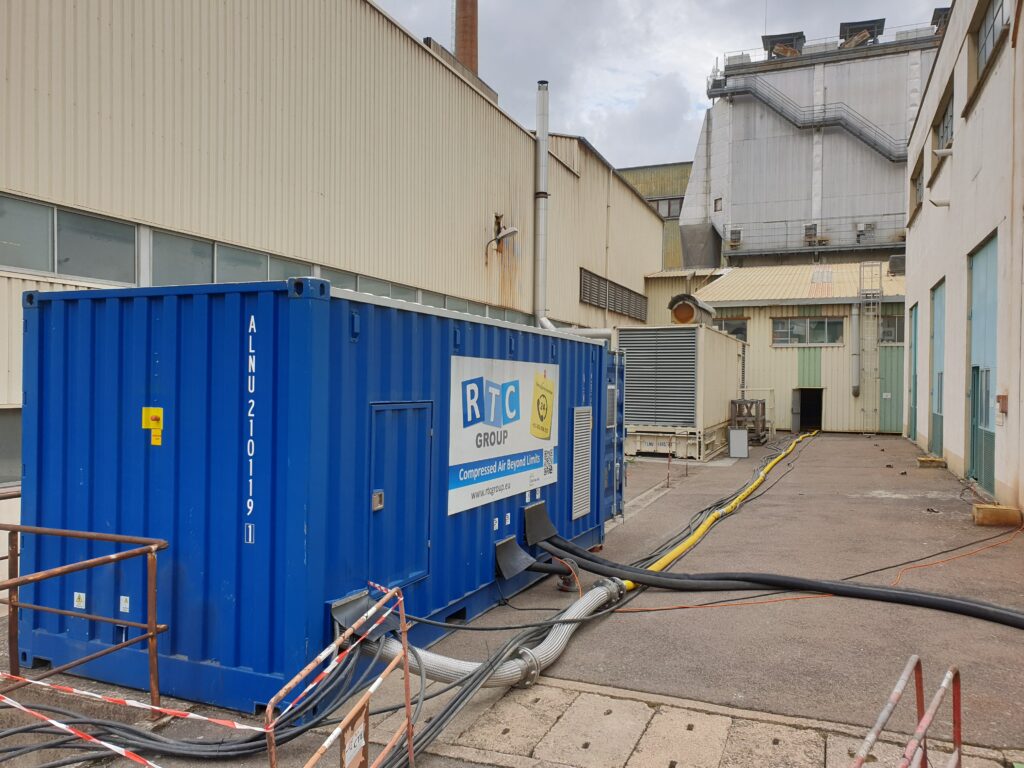
A professional oil-free compressor rental is not simply the loan of a machine. A complete rental package typically includes the compressor itself, all ancillary equipment needed to make it operational, and the engineering, logistics, installation, and start-up services required to get it running safely on your site. You receive a working compressed air system, not a collection of components to assemble yourself.
Ancillary equipment commonly included alongside the compressor covers:
- Air dryers: refrigerant dryers for general industrial drying and desiccant dryers for applications requiring very low moisture content or where pipework may be exposed to freezing temperatures
- Air receivers for storage and pressure stabilisation
- Power transformers where the site supply does not match the compressor’s voltage requirements
- All interconnecting pipework, hoses, and fittings needed for the temporary installation
The engineering scope matters as much as the equipment list. A specialist rental provider handles site assessment, system design, transport, mechanical installation, electrical connection, and commissioning. For industries where air purity is a process or regulatory requirement, the rental equipment should be capable of delivering air that meets the quality levels defined by ISO 8573-1 Class 0 — a classification that describes the purity of the compressed air itself, specifically confirming that no measurable oil content is present in the air stream. This is a technical air quality standard, not a supplier certification, and it is the equipment and the air it produces that must meet the specification.
RTC Group, for example, structures its oil-free compressor rental as a fully managed service, covering everything from initial system design through to on-site start-up, so clients receive a complete temporary compressed air supply rather than individual pieces of hired equipment.
How quickly can a rented oil-free compressor be deployed on site?
A rented oil-free compressor can typically be mobilised and operational within days of an order being confirmed, provided the rental provider holds the equipment in stock and has the logistics capability to deliver and install it. In genuine emergencies, specialist providers with Europe-wide fleets and in-house installation teams can achieve deployment timescales that a purchase process cannot come close to matching.
The actual deployment timeline depends on several practical factors:
- Site readiness: whether power, water cooling, and connection points are already in place or need to be prepared
- Equipment configuration: a standard low-voltage centrifugal unit is simpler to connect than a medium-voltage machine, which requires engineered protection and auxiliary design even when connecting to an existing supply
- Distance and logistics: for cross-border European deployments, customs, transport routing, and local installation partner coordination add time
- Regulatory requirements: industries with strict air purity or safety standards may require documented pre-commissioning checks before the system goes live
For most planned shutdown scenarios, a rental provider with in-house project management can mobilise within a few days once the site survey is complete. Emergency rental is specifically designed for speed, and providers who operate 24/7 support models are structured to respond outside normal business hours. The key is choosing a supplier with the fleet, the staff, and the technical expertise already in place, because those cannot be improvised at short notice.
What maintenance responsibilities does a renter have for an oil-free compressor?
When you rent an oil-free compressor from a specialist provider, your maintenance responsibilities are minimal. The rental provider retains ownership of the equipment and is responsible for ensuring it is in proper working condition throughout the rental period. Your obligation as the renter is typically limited to operating the equipment within agreed parameters and reporting any faults or abnormal conditions promptly.
In practice, this means the renter is generally responsible for:
- Monitoring operational parameters such as pressure, temperature, and flow within the ranges specified at commissioning
- Ensuring the equipment is not subjected to conditions outside its rated operating environment
- Keeping the installation area clear and maintaining access for service visits
- Notifying the provider immediately if the machine trips, performs abnormally, or shows warning indicators
Scheduled servicing, reactive maintenance, and the supply of replacement parts remain the provider’s responsibility. This is one of the most significant practical advantages of renting over owning. Large oil-free centrifugal compressors and high-pressure units for applications such as PET bottle blowing are technically complex machines. Maintaining them correctly requires specialist knowledge, calibrated tools, and access to manufacturer-approved parts — resources that most industrial facilities do not hold in-house for temporary equipment.
The 24/7 support model offered by specialist rental providers means that if a fault occurs at two in the morning during a critical production run, there is a direct line to engineers who know the equipment and can respond. That level of cover is difficult and expensive to replicate with owned assets.
Which industries benefit most from renting oil-free compressors?
Industries that benefit most from renting oil-free compressors are those where air purity is a production-critical requirement and where compressor failure would cause immediate, measurable harm to product quality, regulatory compliance, or process safety. Food and beverage, pharmaceutical, chemical, metal processing, and PET plastics manufacturing sit at the top of that list, but the case for rental extends across a much broader industrial spectrum.
In food and beverage production, compressed air comes into direct or indirect contact with products and packaging. Oil contamination at any level risks product recalls, regulatory action, and reputational damage. The same logic applies in pharmaceutical manufacturing, where good manufacturing practice (GMP) requirements demand demonstrably contaminant-free air throughout production and packaging processes.
Metal industry applications present some of the most demanding compressed air requirements in industry. In aluminium smelting, large volumes of oil-free compressed air are used continuously for several critical functions: cooling the electrolytic reduction cells — known as pots — that convert alumina into molten aluminium, as well as for pneumatic conveying of alumina powder and for operating control and instrumentation systems. When a primary compressor fails at an aluminium smelter, even a brief interruption to pot cooling can cause thermal damage to the cell lining, with repair costs and production losses running into hundreds of thousands of euros. In steel production, compressed air is used in blast furnace operations, for pneumatic conveying of materials, and for powering automation and control systems across the plant. The consequence of unplanned downtime in either environment is severe, which is why maintaining reliable compressed air supply — including adequate standby capacity — is treated as a safety-critical operational requirement.
This brings the N+1 redundancy principle into focus. Industrial compressed air systems are typically designed so that one additional compressor is available beyond the number required to meet full operational demand. If the standby unit fails or is taken out of service for planned maintenance, the facility is left without a reserve, and any subsequent fault on a running machine could halt production entirely. Renting a temporary compressor to restore N+1 redundancy while the standby unit is repaired or serviced is one of the most common and practically important use cases for industrial compressor rental — and one that does not require a full production emergency to justify.
PET bottle blowing is a specialist case. It requires high-pressure oil-free air, typically at pressures well above standard industrial compressed air systems, and dedicated equipment designed for that duty. Renting purpose-built high-pressure oil-free compressors for this application, rather than attempting to adapt general-purpose equipment, is both safer and more practical.
Chemical and petrochemical plants, glass manufacturers, automotive assembly facilities, textile producers, and gas separation operations all share a common profile: large-scale, continuous processes where unplanned downtime carries a high cost and where air quality standards are set by process requirements rather than preference. For all of them, temporary compressed air solutions provide a reliable safety net when permanent systems are offline or when standby capacity needs to be restored quickly.
Should you rent or buy an oil-free compressor for a long-term project?
For genuinely long-term requirements, meaning several years of continuous, full-capacity use, purchasing an oil-free compressor may eventually become more economical than renting. However, the break-even point is further away than most buyers expect once the full cost of ownership is calculated honestly. For projects measured in months rather than years, or where the future requirement is uncertain, rental remains the more rational choice even at extended durations.
The honest comparison requires accounting for costs that are easy to underestimate when buying:
- Capital cost and financing charges
- Installation, commissioning, and site infrastructure investment
- Ongoing maintenance contracts and spare parts
- Operator training and technical support
- Insurance and compliance documentation
- Residual value risk if the project ends or requirements change
When those costs are totalled and compared against a rental contract that includes all equipment, installation, maintenance, and support, the gap between renting and buying narrows considerably. For projects with an uncertain end date, rental also preserves flexibility: you can scale up, scale down, or return the equipment without writing off a capital asset.
There is also a practical argument for long-term rental that has nothing to do with cost. Specialist rental providers maintain and upgrade their fleets continuously. A rented machine is serviced by engineers who know it, using the correct parts, on a schedule designed for that equipment. An owned machine, by contrast, depends entirely on the buyer’s in-house capability or a third-party service contract, and for highly specialised oil-free centrifugal equipment, finding qualified service engineers is not straightforward.
If you are weighing a long-term requirement and want to understand what a rental arrangement would look like at that scale, reviewing the available rental equipment and speaking directly with RTC Group is the most reliable way to make a properly informed comparison. The right answer depends on your specific application, your site infrastructure, and how confident you are that the requirement will remain constant over the project’s full duration.