
A temporary compressed air supply keeps production lines running by replacing or supplementing a failed or unavailable permanent compressor system with rental equipment installed and commissioned on-site, often within hours. For industrial facilities where compressed air drives critical processes, this kind of rapid intervention is the difference between a brief disruption and a costly, extended shutdown. The sections below address the most common questions plant managers and maintenance engineers ask when evaluating this option.
What happens to a production line when compressed air fails?
When compressed air fails, production stops. Most industrial processes rely on compressed air to power pneumatic tools, actuators, conveyors, blowing systems, and process instrumentation, so a compressor failure immediately halts output. In sectors such as food and beverage, pharmaceutical manufacturing, and metal processing, the consequences extend beyond lost throughput to spoiled product batches, contaminated processes, and breached delivery commitments.
The financial impact compounds quickly. Every hour of unplanned downtime in a large manufacturing facility carries a significant cost in idle labour, missed orders, and potential equipment damage caused by the sudden loss of pressure. In continuous-process industries such as steel production, aluminium smelting, or gas separation, a compressed air failure can force a complete process restart, which is both time-consuming and expensive. In aluminium smelting specifically, compressed air is used to cool the electrolysis cells — known as pots — that run continuously at high temperatures. An interruption to that cooling air supply can cause rapid pot damage and force a costly restart of the entire smelting line.
Beyond the immediate production loss, there are downstream effects. Pneumatic control systems that lose pressure can fail in unsafe states. Moisture-sensitive processes left without dry air can suffer equipment corrosion or product quality failures. These risks explain why many industrial operators treat compressed air as a critical utility on the same level as electricity or cooling water, and why having a contingency plan for compressor failure is an operational necessity rather than an optional precaution.
Need Reliable Oil-Free Compressed Air?
Our experts help you find the right compressed air rental solution for your industrial needs.
How does a temporary compressed air supply work on-site?
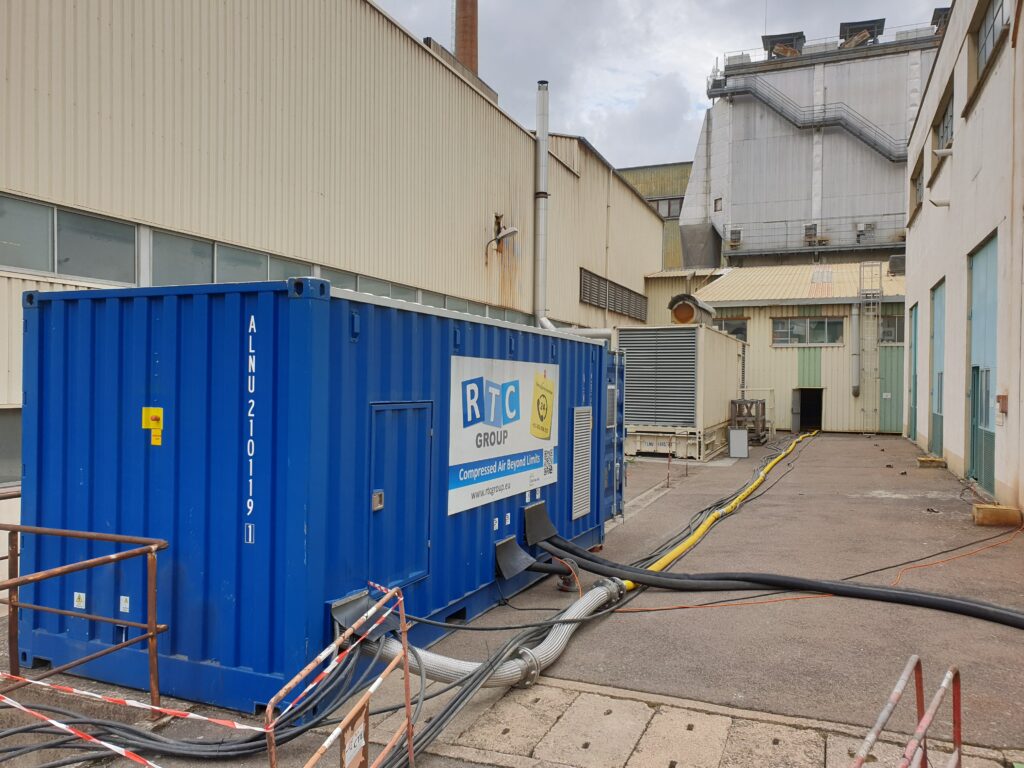
A temporary compressed air supply works by deploying rental compressors and supporting equipment to a site, connecting them to the existing distribution network, and commissioning the system to deliver the required flow and pressure. The rental provider handles engineering, logistics, installation, and start-up, so the client’s team can focus on resuming production rather than managing a complex equipment mobilisation.
In practice, the process begins with a technical assessment of the site’s air demand: the required flow rate in cubic metres per minute, the working pressure, the air quality class needed, and the available power supply. Based on this, the rental provider selects appropriate compressor units, air treatment equipment, and ancillary components. The equipment is then transported to site, positioned, connected to the power supply and air distribution pipework, and started up under supervision.
Connection to the existing distribution system is typically made using flexible hose assemblies rated for the working pressure, which avoids the need for permanent pipework modifications. Where the site operates on a medium-voltage power supply, compressors that connect directly to that supply can eliminate the need for a large temporary transformer, simplifying the installation significantly. Once commissioned, the temporary system operates in parallel with or as a direct replacement for the permanent installation, with the rental provider available to support the system throughout the rental period.
When should a plant switch to a temporary compressed air solution?
A plant should consider a temporary compressed air solution in several situations: an unplanned compressor failure requiring immediate replacement, a failure of the standby compressor that leaves the installation without redundancy, a planned maintenance or overhaul shutdown where the permanent system must be taken offline, and a capacity shortfall during facility expansion or increased production demand. Each scenario has a different lead time and planning requirement, but all are well-suited to rental.
Unplanned failures and emergencies
Emergency compressed air rental is the most time-sensitive use case. When a compressor fails without warning, the priority is restoring air supply as quickly as possible. A specialist rental provider with a well-stocked fleet can mobilise equipment within hours in many cases, bridging the gap while the permanent machine is repaired or replaced. This is particularly valuable in continuous-process industries where even a short outage carries a disproportionate cost.
Standby compressor failure and the N+1 principle
Many industrial compressed air installations are designed around the N+1 redundancy principle: alongside the number of compressors required to meet operational demand, one additional standby unit is kept available to take over if a running machine fails. This reserve capacity is a critical part of the facility’s reliability strategy. When the standby compressor itself develops a fault and must be taken out of service for repair, the installation loses its redundancy buffer — meaning that any subsequent failure of a running machine would immediately halt production with no fallback. In this situation, renting a temporary compressor to restore the N+1 configuration is a practical and often urgent requirement, even though production is currently unaffected. It closes the vulnerability before it becomes a crisis.
Planned shutdowns and scheduled maintenance
Planned maintenance shutdowns are the most straightforward application for temporary air supply. Because the outage is scheduled in advance, there is time to assess requirements carefully, select the right equipment, and arrange a smooth handover. Many plants rent a temporary system to cover annual overhauls, compressor rebuilds, or infrastructure upgrades, ensuring that production in unaffected areas continues without interruption. Rental arrangements for planned work can run from a few weeks to several months depending on the scope of the maintenance programme.
Capacity gaps during expansion
When production ramps up faster than permanent infrastructure can be upgraded, or when a new production line is being commissioned, temporary rental compressors provide additional capacity without a long-term capital commitment. This flexibility makes rental an economically sensible bridge between current capacity and the completion of a permanent installation.
What does ISO 8573-1 Class 0 mean for rental compressed air?
ISO 8573-1 is the international standard that classifies the purity of compressed air by defining maximum allowable concentrations of contaminants including particulates, water, and oil. Class 0 is the most stringent classification within that standard, specifying that the compressed air contains no detectable oil in any form — whether as aerosol, liquid, or vapour — at levels defined by the user or equipment manufacturer. It is important to understand that Class 0 is a technical specification describing air quality, not a certification that a rental provider holds as an organisation. What matters in practice is whether the equipment being supplied is capable of delivering compressed air that meets Class 0 requirements for your specific application.
The distinction between Class 0 air quality and lower purity classes is significant in practice. Oil-lubricated compressors fitted with downstream filtration can achieve low oil content, but they cannot guarantee the absence of oil carryover in the way that a true oil-free compression process can. In industries such as food and beverage, pharmaceutical manufacturing, and electronics production, even trace oil contamination can render a product batch unusable, trigger regulatory non-compliance, or damage sensitive downstream equipment.
When a plant rents a compressor to replace its permanent system, it needs confidence that the temporary solution will not introduce contamination risks that the permanent system was designed to prevent. Specifying oil-free compressor technology for the rental package, and verifying that the equipment is appropriate for the air quality class your process requires, is the right approach. This allows the plant to maintain its quality and compliance standards throughout the rental period without additional risk management measures.
What equipment is included in a temporary compressed air package?
A temporary compressed air package typically includes the compressor unit itself, air treatment equipment such as refrigerant or desiccant dryers, air receivers for pressure buffering, power supply components including transformers and distribution equipment, and all hoses, cables, and connection hardware needed to integrate the system with the site. The exact composition depends on the application and air quality requirements.
The compressor is the core of the package. Depending on the site’s power supply and air demand, this might be a low-voltage electric unit, a medium-voltage unit that connects directly to an existing medium-voltage network, a diesel-powered unit for sites without a suitable mains supply, or a hybrid unit that starts on diesel and switches to mains electricity when available. For large industrial consumers such as steel mills or aluminium smelters, centrifugal compressors capable of delivering very high flow rates are the appropriate choice.
Air treatment is equally important. Desiccant dryers are used where the application demands exceptionally dry air, achieving pressure dew points as low as minus 40 degrees Celsius, which is essential for moisture-sensitive processes and outdoor installations in cold climates. Refrigerant dryers are suited to less demanding drying requirements. Air receivers provide a buffer volume that smooths out demand fluctuations and protects the compressor from rapid load cycling.
Published project records illustrate the range of equipment that a complete temporary installation can involve. A sugar factory project in the Netherlands, for example, included two compressors with a combined capacity supported by desiccant dryers, high-pressure boosters, large buffer receivers, and autonomous cooling-water systems, all connected with hundreds of metres of electrical cable. An aluminium smelter project in Iceland involved medium-voltage distribution equipment, a step-down transformer, multiple desiccant dryers, and cooling-water chillers — reflecting the scale and complexity that large industrial sites require. In that type of facility, compressed air serves multiple critical functions simultaneously: supplying instrument air for process control, providing cooling air for the electrolysis pots, and supporting pneumatic conveying of alumina. Each of these functions has its own flow rate, pressure, and air quality requirement, which must all be addressed within the rental package. You can explore the full rental equipment range to understand what a package for your specific application might include.
How quickly can a temporary compressed air system be mobilised?
A temporary compressed air system can be mobilised within hours to a few days, depending on the complexity of the installation, the equipment required, and the site’s location relative to the rental provider’s fleet. For straightforward emergency deployments using standard equipment, same-day or next-day mobilisation is achievable when the provider maintains a ready fleet and handles logistics in-house.
Speed of mobilisation depends on several factors. The availability of the right compressor size and type in the rental fleet is the primary constraint. A provider that owns a large, diverse fleet across multiple equipment families can respond faster than one that needs to source equipment externally. Equally important is whether the provider manages its own logistics and installation, since coordinating multiple subcontractors adds time and risk to an emergency response.
Site preparation also affects how quickly air can flow. If the connection point, power supply, and access route are clear and well-documented, installation proceeds quickly. If the site requires electrical assessments, permits, or significant pipework adaptation, the timeline extends accordingly. This is why experienced rental providers conduct a rapid technical assessment at the outset, identifying and resolving potential obstacles before the equipment arrives rather than discovering them during installation.
For planned shutdowns, the mobilisation question is less about speed and more about precision: arriving at the right time, with the right equipment fully tested, so that the transition from permanent to temporary supply is seamless. In both emergency and planned scenarios, RTC Group offers oil-free compressor rental with 24/7 support and single-point-of-contact project management, removing the coordination burden from the plant’s own team — which is often the most practical advantage of working with a specialist rather than a general equipment hire company.
If you are evaluating options for your facility, speaking directly with an RTC Group compressed air specialist is the fastest way to get an accurate picture of what mobilisation would look like for your specific site and requirements.