

ISO Class 0 means that the compressed air contains no detectable oil whatsoever: not aerosols, not vapour, not particles. It is the highest purity classification defined by the ISO 8573-1 standard, and it exists specifically for manufacturing environments where even trace oil contamination would compromise product quality, process integrity, or regulatory compliance.
For manufacturers, Class 0 is not simply a quality upgrade: it is a production requirement. Industries such as food and beverage, pharmaceutical manufacturing, and electronics production cannot tolerate oil in their air supply, making ISO Class 0 oil-free compressed air the only technically acceptable choice. The sections below answer the most common questions manufacturers ask before specifying, sourcing, or renting a Class 0 system.
How is ISO Class 0 different from other compressed air purity classes?
ISO Class 0 is the strictest purity tier in the ISO 8573-1 compressed air quality standard, sitting above Classes 1 through 5. While Classes 1 to 5 define progressively higher allowable concentrations of oil aerosol, vapour, and particles, ISO Class 0 sets the limit at zero detectable oil in any form: aerosol, liquid, or vapour. No measurable contamination is permitted.
The ISO 8573-1 standard classifies compressed air across three contaminant categories: solid particles, water content, and oil content. For oil, Class 1 permits up to 0.01 mg/m³, Class 2 up to 0.1 mg/m³, and Class 3 up to 1 mg/m³. Each step up the scale represents a tenfold increase in allowable contamination. ISO Class 0, by contrast, requires that oil content be stated and tested by the equipment manufacturer, with the declared limit being stricter than Class 1, effectively meaning zero oil under defined test conditions.
This distinction matters enormously in practice. A Class 1 system might be acceptable for general pneumatic tooling or non-contact automation. Class 0 is specified when the compressed air comes into direct or indirect contact with a product, a sensitive surface, or a process that cannot tolerate contamination at any level. The gap between Class 1 and Class 0 is not merely numerical: it represents a fundamentally different design philosophy in the compressor itself, which must eliminate oil from the compression cycle entirely rather than filter it out downstream.
What industries require ISO Class 0 oil-free compressed air?
Industries that require ISO Class 0 oil-free compressed air are those where oil contamination would directly damage a product, violate a regulatory requirement, or create a safety risk. The most critical sectors include food and beverage production, pharmaceutical manufacturing, electronics and semiconductor fabrication, and medical device production, but the list extends well beyond these.
In food and beverage facilities, compressed air frequently contacts packaging materials, conveyor systems, and in some cases the product itself. Any oil carry-over would constitute contamination under food safety regulations, making Class 0 air a non-negotiable requirement rather than a preference. Pharmaceutical manufacturers face equally strict constraints: GMP-compliant processes require sterile, contaminant-free air, and regulatory bodies across Europe expect documented evidence of air purity.
Beyond the obvious clean-room sectors, ISO Class 0 compressed air is also essential in industries that are sometimes overlooked:
- PET bottle blowing: high-pressure oil-free air is used directly in the blowing process, and any oil residue inside the bottle would be unacceptable for food-grade packaging
- Chemical and petrochemical plants: where oil contamination can interfere with reactions or create hazardous conditions
- Textile and fibre production: where oil can stain or degrade yarn quality
- Steel and aluminium production: large volumes of Class 0 air are used across multiple process stages. In steelmaking, oil-free air is used for lance blowing during basic oxygen furnace operations, where oil contamination would affect melt chemistry. In aluminium smelting, oil-free compressed air is used to cool electrolysis cells — known as pots — where any oil carry-over could contaminate the aluminium melt and compromise the quality of the primary metal
- Glass manufacturing: where air purity affects surface integrity and optical clarity
- Gas separation: where oil contamination in the air stream would compromise the purity of the separated gas product
The common thread across all these sectors is that the cost of contamination — in product recalls, regulatory penalties, or process failures — far exceeds the cost of specifying and sourcing oil-free compressed air that meets Class 0 purity requirements from the outset.
What’s the difference between oil-free and oil-lubricated compressors?
The fundamental difference between oil-free and oil-lubricated compressors is where oil is used in the compression process. Oil-lubricated compressors use oil inside the compression chamber to seal clearances, reduce friction, and cool the air during compression. Oil-free compressors use alternative materials and designs, such as PTFE-coated components, water injection, or precision-engineered clearances, so that no oil ever enters the compression chamber.
In an oil-lubricated machine, oil mixes directly with the compressed air during compression. Downstream filtration and separators remove the bulk of this oil, but they cannot guarantee zero carry-over across all operating conditions, temperatures, and filter states. As filters age or operating temperatures shift, trace oil can pass through. This is why even a well-maintained oil-lubricated compressor with high-quality downstream filtration cannot reliably deliver compressed air that meets ISO Class 0 purity requirements: the oil is present in the process, and filtration is always a mitigation rather than an elimination.
An oil-free compressor removes oil from the equation entirely. There is no oil in the compression stage, so there is no oil to carry over into the air stream. This is the only engineering approach that can support a genuine ISO Class 0 purity declaration. The design consequences include different bearing arrangements, more sophisticated cooling systems, and in the case of large centrifugal machines, aerodynamic compression stages that require no lubrication at all in the air path.
It is worth noting that oil-free does not mean the machine contains no oil anywhere: bearings and gearboxes in many oil-free designs are still oil-lubricated, but these systems are fully sealed and isolated from the compression chamber. The air path itself remains completely oil-free. This distinction between the air path and the mechanical drive is what defines a true oil-free compressor and underpins the ability to verify that the output air meets Class 0 purity requirements.
How is ISO Class 0 air purity tested and verified?
ISO Class 0 air purity is established by the compressor manufacturer through testing that demonstrates the compressed air output contains no detectable oil under defined operating conditions. The manufacturer declares the oil content limit, which must be stricter than the Class 1 threshold of 0.01 mg/m³, and supports this declaration with documented test evidence. Independent test bodies can audit and verify the manufacturer’s test methodology and results, providing additional assurance for end users who require traceable documentation.
The testing process follows the measurement methods defined in ISO 8573-2 (aerosol oil), ISO 8573-3 (liquid oil), and ISO 8573-5 (vapour oil), which together cover all three forms in which oil can appear in compressed air. Samples are taken at the compressor outlet under representative operating conditions, and the results must demonstrate that oil content is below the declared Class 0 limit across all three categories simultaneously.
For manufacturers sourcing or renting Class 0 equipment, the practical implication is that verified air purity is equipment-specific: it applies to a particular compressor model tested under defined conditions, not to a brand or product family in general. When specifying rental equipment, it is important to confirm that the individual unit has documented test evidence supporting Class 0 air purity, not simply that the supplier describes their fleet as oil-free.
Reputable suppliers provide documentation alongside the equipment. Oil-free compressor rental from a specialist operator should always come with traceable test documentation, and any credible supplier will be able to produce the relevant evidence on request. Facilities with internal quality management systems or external audits — such as those operating under ISO 9001 or GMP frameworks — will typically require this documentation as part of their supplier qualification process.
When should manufacturers rent rather than buy a Class 0 compressor?
Manufacturers should rent a Class 0 compressor rather than buy one when the need is temporary, urgent, or uncertain in scope. The most common scenarios are emergency compressor failure, planned maintenance shutdowns, capacity gaps during facility expansion, and the need to restore N+1 redundancy when a standby unit is unavailable — situations where the compressed air requirement is real and immediate, but a capital purchase is not justified or not fast enough to solve the problem.
Many industrial compressed air installations are designed on an N+1 basis: for every compressor required to meet operational demand, one additional standby unit is kept available to maintain production continuity in the event of a failure. When that standby compressor goes offline — whether for unplanned repair or scheduled maintenance — the redundancy buffer disappears entirely. In this situation, a temporary rental unit can restore the N+1 configuration and protect the facility against any further unplanned downtime until the permanent standby is returned to service.
The case for renting becomes particularly strong when the following conditions apply:
- Speed of deployment matters: a compressor failure mid-production cannot wait weeks for a capital procurement process; rental equipment can typically be mobilised within days
- Standby redundancy needs to be restored: when a standby unit fails or is taken out of service for repair, a rental compressor can fill the N+1 gap and maintain the facility’s resilience until the permanent unit is back online
- The requirement is time-limited: a scheduled plant overhaul or a bridge period during new equipment installation does not warrant a capital investment that will sit idle afterwards
- Capacity requirements are uncertain: during facility expansion or process trials, rental allows manufacturers to match air supply to evolving demand without committing to a fixed asset
- Site infrastructure is temporary or constrained: rental specialists can supply diesel or hybrid oil-free units for sites where mains power is unavailable or insufficient, removing infrastructure barriers
- Full project support is needed: a specialist rental provider handles engineering, logistics, installation, and commissioning as part of the service, which is often faster and lower-risk than managing a capital installation internally
The total cost comparison also favours rental in shorter-duration scenarios. Capital purchase of a large oil-free centrifugal compressor carries significant upfront expenditure, ongoing maintenance obligations, and asset management complexity. Rental converts this into a predictable operational cost with no residual liability when the project ends.
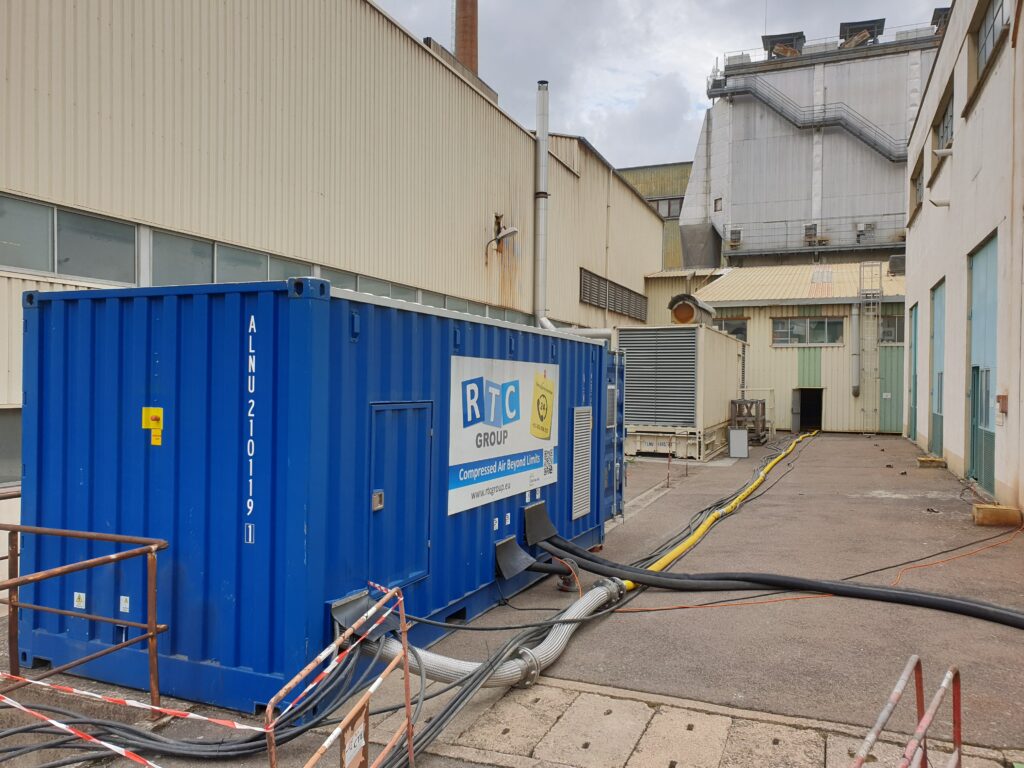
For manufacturers across Europe facing any of these situations, RTC Group’s end-to-end service covers the full temporary compressed air supply, from equipment selection and delivery through to installation, start-up, and ongoing support, with ISO Class 0-rated equipment and a single point of contact available around the clock. Explore the full rental equipment range or get in touch directly to discuss your specific requirements with the RTC Group team.