
Technically oil-free versus 100% oil-free compressed air
Technically oil-free vs. 100% oil-free compressed air: differences according to ISO 8573-1
Compressed air is an indispensable energy source in industry. But not every compressed air quality is suitable for every application. The oil content in compressed air, in particular , plays a major role in product quality, process safety, and maintenance costs. In this blog post, we explain the difference between technically oil-free compressed air and 100% oil-free compressed air , as defined in ISO 8573-1 .
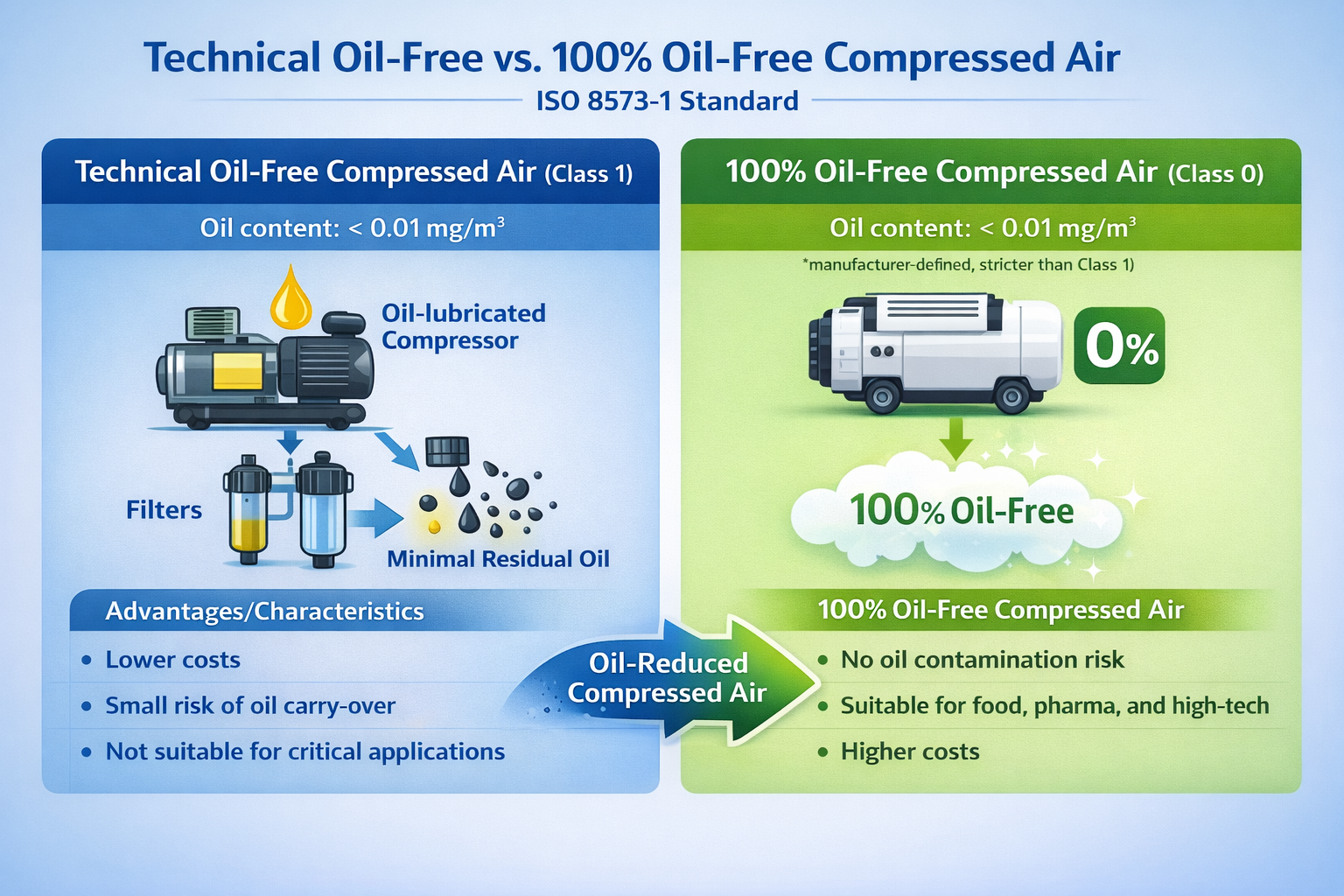
ISO 8573-1 is the international standard that classifies the quality of compressed air based on:
- solid particles
- water
- oil
total oil content is considered : a combination of oil aerosols and oil vapor. The standard distinguishes between Class 1 and Class 0 , which are often confused.
Technical oil-free compressed air (ISO 8573-1 Class 1)
Technically oil-free compressed air meets ISO Class 1 , with a maximum oil content of 0.01 mg/m³ . This compressed air is usually produced with an oil-lubricated compressor , combined with high-quality filters that almost completely remove the oil. An activated carbon filter is often added to reduce the residual oil to 0.003 mg/m³.
Although this air is very clean in practice, it is not completely oil-free .
Advantages of technically oil-free compressed air
- Lower investment costs
- Energy-efficient solution
- Suitable for most industrial applications
- Widely applicable in production environments
Disadvantages
- Small chance of oil in the compressed air if the filter fails (certainly not unthinkable, so a risk)
- Not suitable for critical processes
- Regular and correct maintenance is necessary
100% oil-free compressed air complies with ISO Class 0. This class is stricter than Class 1 and requires an oil content of less than 0.01 mg/m³ , with a manufacturer-guaranteed value. The compressed air is generated using oil-free compressors , thus structurally eliminating oil contamination.
Benefits of 100% oil-free compressed air
- Maximum security against oil pollution
- Ideal for food & beverage , pharmaceutical and electronics
- Protects product quality and brand reputation
- Minimal chance of rejection and process disruptions
Disadvantages
- Higher purchase costs
- Often higher energy consumption
- More complex installation and technology
Technically oil-free or 100% oil-free: what’s the right choice?
The right compressed air quality depends entirely on the application. For many industrial processes, technically oil-free compressed air (Class 1) is a reliable and cost-effective solution. In sectors where even the slightest oil contamination is unacceptable, such as the food industry, pharmaceuticals, or medical technology , 100% oil-free compressed air (Class 0) is the best choice.
Conclusion
A conscious choice for the correct compressed air quality according to ISO 8573-1 prevents product contamination, reduces risks, and saves costs in the long run. By understanding the difference between technically oil-free compressed air and 100% oil-free compressed air , you make a future-proof and safe choice for your process.